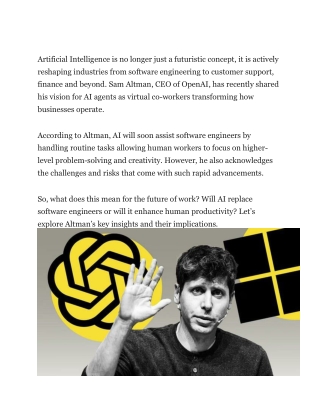
Artificial Intelligence is no longer just a futuristic concept, it is actively reshaping industries from software engineering to customer support, finance and beyond. Sam Altman, CEO of OpenAI, has recently shared his vision for AI agents as virtual co-workers transforming how businesses operate.
95 Contenus publiés
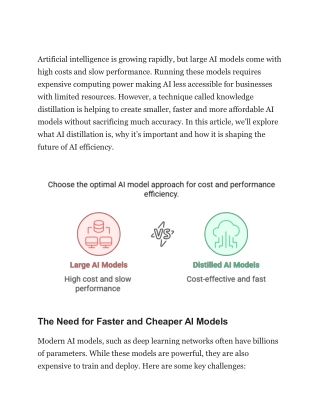
Page 4 sur 4Artificial intelligence is growing rapidly, but large AI models come with high costs and slow performance. Running these models requires expensive computing power making AI less accessible for businesses with limited resources. However, a technique called knowledge distillation is helping to create smaller, faster and more affordable AI models without sacrificing much accuracy. In this article, weu2019ll explore what AI distillation is, why itu2019s important and how it is shaping the future of AI efficiency.
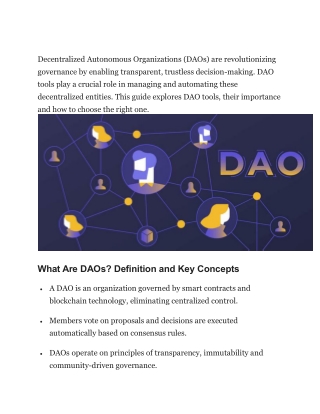
Decentralized Autonomous Organizations (DAOs) are revolutionizing governance by enabling transparent, trustless decision-making. DAO tools play a crucial role in managing and automating these decentralized entities. This guide explores DAO tools, their importance and how to choose the right one.
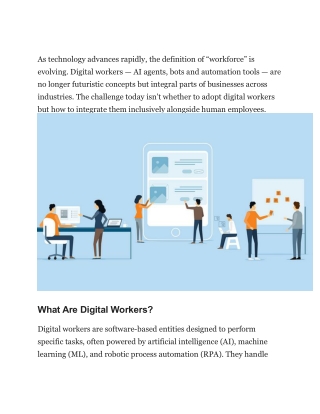
As technology advances rapidly, the definition of u201cworkforceu201d is evolving. Digital workers u2014 AI agents, bots and automation tools u2014 are no longer futuristic concepts but integral parts of businesses across industries. The challenge today isnu2019t whether to adopt digital workers but how to integrate them inclusively alongside human employees.
The SaaS (Software as a Service) industry continues to be a transformative force in the global economy, driving innovation and reshaping how businesses operate. As we approach 2025, several emerging trends and developments are set to redefine the landscape of SaaS. From advancements in AI agents to evolving pricing models, hereu2019s a comprehensive look at whatu2019s ahead for the SaaS industry.

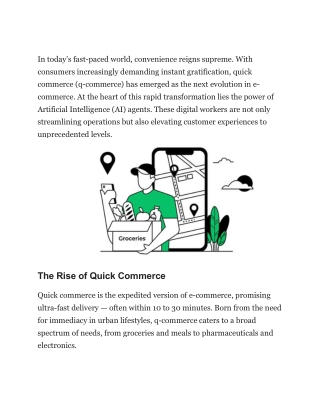
In todayu2019s fast-paced world, convenience reigns supreme. With consumers increasingly demanding instant gratification, quick commerce (q-commerce) has emerged as the next evolution in e-commerce. At the heart of this rapid transformation lies the power of Artificial Intelligence (AI) agents. These digital workers are not only streamlining operations but also elevating customer experiences to unprecedented levels.
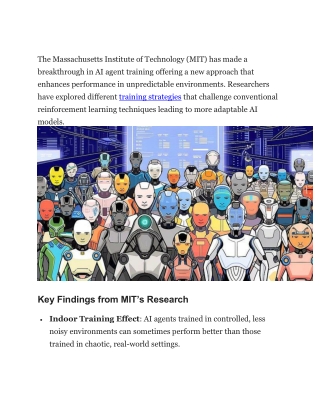
The Massachusetts Institute of Technology (MIT) has made a breakthrough in AI agent training offering a new approach that enhances performance in unpredictable environments. Researchers have explored different training strategies that challenge conventional reinforcement learning techniques leading to more adaptable AI models.
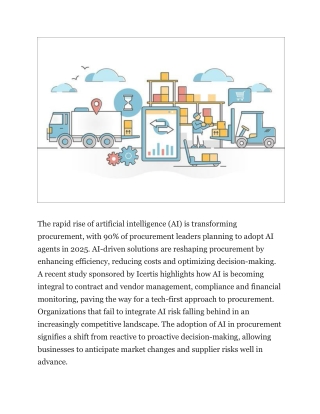
The rapid rise of artificial intelligence (AI) is transforming procurement, with 90% of procurement leaders planning to adopt AI agents in 2025. AI-driven solutions are reshaping procurement by enhancing efficiency, reducing costs and optimizing decision-making. A recent study sponsored by Icertis highlights how AI is becoming integral to contract and vendor management, compliance and financial monitoring, paving the way for a tech-first approach to procurement.
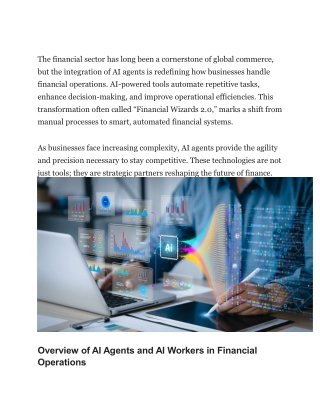
The financial sector has long been a cornerstone of global commerce, but the integration of AI agents is redefining how businesses handle financial operations. AI-powered tools automate repetitive tasks, enhance decision-making, and improve operational efficiencies. This transformation often called u201cFinancial Wizards 2.0,u201d marks a shift from manual processes to smart, automated financial systems.
The marketing landscape is undergoing a seismic shift, driven by advancements in artificial intelligence (AI). At the heart of this transformation are AI agents, sophisticated tools that empower marketers to better connect with their audiences. These agents are not just a trend; they are rapidly becoming a cornerstone for successful marketing strategies. In this blog, weu2019ll explore why mastering AI agents is essential for modern marketers and how they can unlock unprecedented opportunities.
Artificial Intelligence (AI) has been making headlines across industries. OpenAI, a leader in this space has just unveiled its latest AI, sparking conversations about its potential. This blog dives into why this new AI has captured the tech worldu2019s attention and explores related trends and envisions the future shaped by AI.
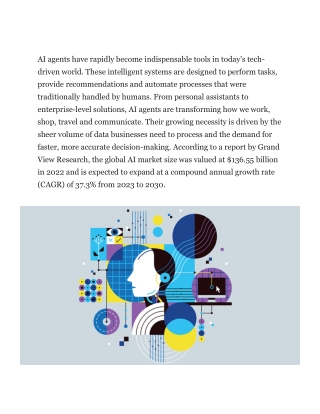
AI agents have rapidly become indispensable tools in todayu2019s tech-driven world. Their growing necessity is driven by the sheer volume of data businesses need to process and the demand for faster, more accurate decision-making.
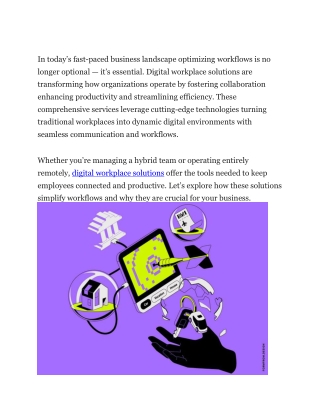
In todayu2019s fast-paced business landscape optimizing workflows is no longer optional u2014 itu2019s essential. Digital workplace solutions are transforming how organizations operate by fostering collaboration enhancing productivity and streamlining efficiency. These comprehensive services leverage cutting-edge technologies turning traditional workplaces into dynamic digital environments with seamless communication and workflows.
Fraud has become an ever-present challenge in todayu2019s digital world. With increasing online transactions and sophisticated fraud techniques, businesses and individuals are at constant risk. Fraudulent activities not only harm companies financially but also erode customer trust. This is where artificial intelligence (AI) steps in as a game-changer, offering advanced tools to detect and prevent fraud effectively.
The blockchain ecosystem has witnessed rapid growth, with Solana emerging as a standout platform. Known for its high speed, low transaction costs and scalability, Solana has become a popular choice for decentralized applications (DApps). At the heart of Solanau2019s architecture lies Rust, a powerful programming language that ensures reliability and performance.
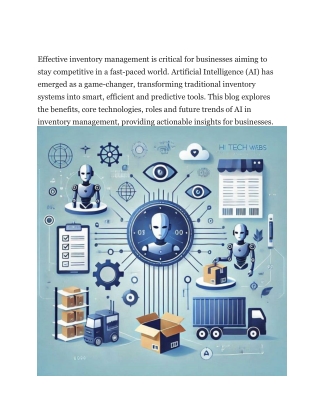
Effective inventory management is critical for businesses aiming to stay competitive in a fast-paced world. Artificial Intelligence (AI) has emerged as a game-changer, transforming traditional inventory systems into smart, efficient and predictive tools. This blog explores the benefits, core technologies, roles and future trends of AI in inventory management, providing actionable insights for businesses.
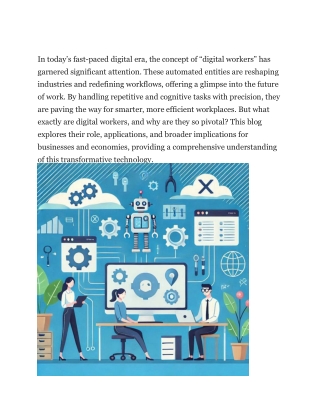
In todayu2019s fast-paced digital era, the concept of u201cdigital workersu201d has garnered significant attention. These automated entities are reshaping industries and redefining workflows, offering a glimpse into the future of work.
In todayu2019s dynamic market landscape, accurately predicting demand is crucial for businesses to optimize operations, reduce costs and improve customer satisfaction. Traditional methods of demand forecasting often fall short due to their reliance on historical data and static models.
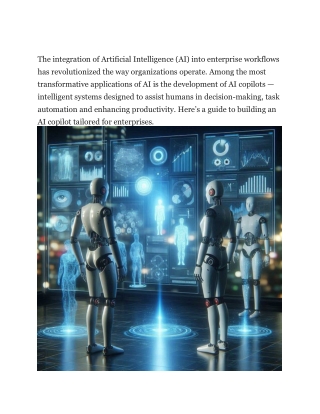
The integration of Artificial Intelligence (AI) into enterprise workflows has revolutionized the way organizations operate. Among the most transformative applications of AI is the development of AI copilots u2014 intelligent systems designed to assist humans in decision-making, task automation and enhancing productivity. Hereu2019s a guide to building an AI copilot tailored for enterprises.
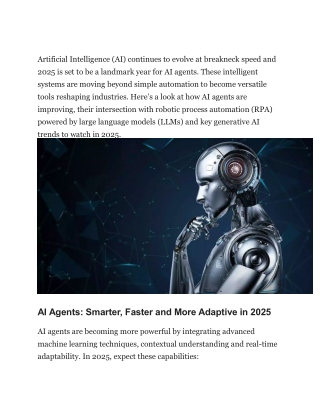
Artificial Intelligence (AI) continues to evolve at breakneck speed, and 2025 is set to be a landmark year for AI agents. Here's a look at how AI agents are improving, their intersection with robotic process automation (RPA) powered by large language models (LLMs), and key generative AI trends to watch in 2025.
Google has recently unveiled a comprehensive whitepaper shedding light on the transformative capabilities of generative AI agents.
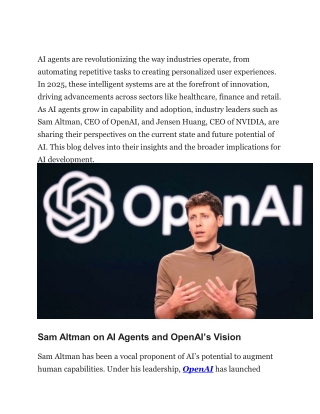
As AI agents grow in capability and adoption, industry leaders such as Sam Altman, CEO of OpenAI, and Jensen Huang, CEO of NVIDIA, are sharing their perspectives on the current state and future potential of AI.
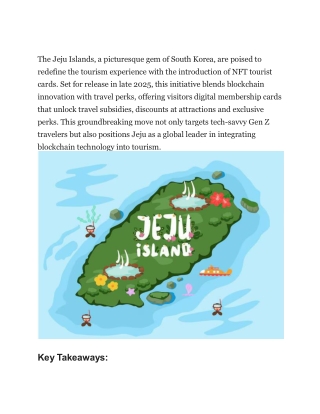
With the NFT tourism card project, South Korea is expandingr blockchainu2019s footprint into a new domain. The initiative not onlyr showcases the versatility of blockchain but also demonstrates Koreau2019sr commitment to staying ahead in the digital economy.