The AI Revolution in Demand Forecasting
0 likes | 12 Vues
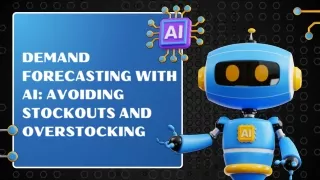
In todayu2019s dynamic market landscape, accurately predicting demand is crucial for businesses to optimize operations, reduce costs and improve customer satisfaction. Traditional methods of demand forecasting often fall short due to their reliance on historical data and static models.


The AI Revolution in Demand Forecasting
E N D
Presentation Transcript
In today’s dynamic market landscape, accurately predicting demand is crucial for businesses to optimize operations, reduce costs and improve customer satisfaction. Traditional methods of demand forecasting often fall short due to their reliance on historical data and static models. Enter Artificial Intelligence (AI) — a transformative tool that leverages machine learning (ML), deep learning and advanced analytics to revolutionize demand forecasting. How AI Demand Forecasting Works AI-powered demand forecasting combines historical data with real- time information, advanced algorithms and external factors to provide accurate predictions. Here’s a breakdown of how it works: 1.Data Collection: AI systems gather data from various sources, including sales history, customer behavior, market trends, weather patterns and social media insights. 2.Data Preprocessing: Collected data is cleaned, normalized and structured to ensure quality and consistency. 3.Algorithm Selection: Machine learning models, such as time- series analysis, neural networks, or gradient boosting, are selected based on the complexity and nature of the data. 4.Model Training: The AI system trains on historical data to identify patterns, correlations and anomalies.
5.Forecasting and Optimization: The trained model generates forecasts and can optimize inventory, pricing and resource allocation. 6.Continuous Improvement: AI models evolve through feedback loops, improving accuracy over time by learning from new data. Importance of AI in Demand Forecasting AI-driven demand forecasting addresses the limitations of traditional methods by:
Enhancing Accuracy: It accounts for complex variables and real- time data, reducing errors. Improving Agility: AI enables rapid adjustments to forecasts based on sudden market changes. Reducing Costs: By optimizing inventory and reducing overstock or stockouts, businesses save significantly. Supporting Strategic Planning: Accurate forecasts guide better decision-making in marketing, operations and supply chain management. Applications of AI in Demand Forecasting AI’s versatility allows its application across various industries, such as: Retail: Predicting product demand, seasonal trends, and customer preferences. For instance, a global retail chain implemented AI to analyze shopping patterns during holiday seasons, leading to a 15% increase in sales due to better stock availability and promotional timing. Manufacturing: Optimizing production schedules and inventory levels. A leading car manufacturer used AI to predict demand for specific vehicle models, reducing production delays and aligning supply with market needs.
Healthcare: Anticipating demand for medications, medical supplies, and hospital resources. A regional hospital network adopted AI to forecast patient inflow during flu seasons, ensuring adequate staffing and resource allocation. E-commerce: Forecasting sales trends and personalizing recommendations. An online marketplace leveraged AI to predict demand for trending gadgets, enabling timely restocking and enhancing customer satisfaction. Transportation: Planning fleet operations and optimizing routes. A logistics company integrated AI to predict delivery volumes, streamlining fleet management and reducing operational costs.
Factors Influencing the Accuracy of AI-Based Demand Forecasting The accuracy of AI-driven demand forecasting depends on several critical factors:
1.Quality of Data: Accurate forecasts require high-quality data that is comprehensive, clean and up-to-date. Incomplete or noisy data can skew predictions. 2.Model Selection: Choosing the right machine learning model is crucial. Complex models may be necessary for intricate datasets, while simpler models might suffice for straightforward patterns. 3.External Variables: Incorporating external factors such as economic indicators, weather conditions and market trends enhances predictive accuracy. 4.Real-Time Insights: Timely updates to data ensure that forecasts reflect current market dynamics, enabling businesses to respond proactively. 5.Continuous Monitoring and Feedback: Regularly evaluating model performance and incorporating feedback improve the system’s accuracy over time. 6.Integration with Business Processes: Seamless integration of AI forecasts into decision-making workflows ensures that predictions are actionable and aligned with organizational goals. Use Cases of AI in Demand Forecasting 1.Inventory Management: Retailers use AI to predict sales spikes and adjust inventory accordingly.
2.Dynamic Pricing: AI algorithms forecast demand fluctuations, enabling real-time pricing adjustments. 3.Supply Chain Optimization: AI predicts potential disruptions and suggests proactive measures. 4.Energy Demand Forecasting: Utilities use AI to predict electricity demand and adjust grid operations. 5.Food and Beverage: Restaurants and food suppliers forecast ingredient needs to minimize waste. Benefits of AI in Demand Forecasting Enhanced Forecast Accuracy: ML models reduce errors compared to traditional methods. Cost Efficiency: Optimized inventory and reduced waste save costs. Improved Customer Experience: Businesses meet customer demands more effectively. Scalability: AI systems handle large datasets and adapt to growing business needs. Proactive Decision-Making: Real-time insights empower businesses to act swiftly. Impact of AI on Businesses
AI-driven demand forecasting has a profound impact on businesses, including: Increased Revenue: By aligning supply with demand, businesses capitalize on sales opportunities. Risk Mitigation: AI identifies potential risks and offers solutions proactively. Sustainability: Efficient resource utilization minimizes waste and environmental impact. Competitive Advantage: Businesses leveraging AI gain a significant edge over competitors using traditional methods.
AI Solutions for Demand Forecasting Leading AI solutions for demand forecasting include: Amazon Forecast: A fully managed service for accurate forecasting. SAP Integrated Business Planning: Combines advanced analytics with machine learning. Microsoft Azure AI: Offers tools for demand forecasting and inventory optimization.
Blue Yonder: Provides end-to-end supply chain solutions with AI-driven demand planning. Implementation of AI in Demand Forecasting Implementing AI for demand forecasting involves several key steps: 1.Define Objectives: Identify goals such as improving forecast accuracy or reducing costs. 2.Select the Right Tools: Choose platforms and algorithms suited to your industry and data needs. 3.Data Preparation: Gather, clean and organize data from relevant sources. 4.Model Development: Collaborate with data scientists to develop and train models. 5.Integration: Seamlessly integrate AI forecasts into existing business processes. 6.Monitor and Optimize: Continuously monitor performance and refine models as needed.
Final Thoughts AI in demand forecasting is not just a technological upgrade; it’s a strategic imperative for businesses aiming to thrive in a competitive market. By leveraging AI’s capabilities, companies can make data- driven decisions, enhance operational efficiency and deliver superior customer experiences. Companies that embrace this change will not only gain a competitive edge but will also set new standards for operational excellence. The adoption of AI in demand forecasting transforms from a reactive process to a proactive strategy, enabling businesses to anticipate market trends and respond effectively. This shift reduces uncertainties and empowers organizations to optimize their resources and strategies for long-term success. Furthermore, the integration of AI fosters innovation, allowing businesses to explore new possibilities in product development, customer engagement and market expansion.
As AI technologies continue to advance, their potential to redefine demand forecasting and drive sustainable growth across industries will become increasingly evident.