Mendel’s Legacy
Mendel’s Legacy. Chapter 9-1. Objectives. Describe Mendel’s Law of Segregation and Independent Assortment through patterns of inheritance Use Punnett squares to determine probablility of genotype and phenotype Draw monohybrid and dihybrid crosses. Vocabulary. Allele Codominance

Mendel’s Legacy
E N D
Presentation Transcript
Mendel’s Legacy Chapter 9-1
Objectives • Describe Mendel’s Law of Segregation and Independent Assortment through patterns of inheritance • Use Punnett squares to determine probablility of genotype and phenotype • Draw monohybrid and dihybrid crosses
Vocabulary • Allele • Codominance • Complete Dominance • Dihybrid cross • Dominant • Genetics • Genotype • Heredity • Heterozygous • Homozygous • Incomplete dominance • Law of Independent assortment • Law of segregation • Monohybrid cross • Phenotype • Probability • Punnett square • Pure • Recessive • Strain • Trait
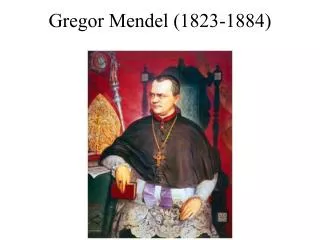
Mendel • Heredity is the transmission of characteristics from parents to offspring • Observed 7 traits (characteristics) of pea plants and wanted to explain variations • Controlled pollination (pollen from male anther transferred to female stigma) • Self-pollination pollinates same flower or same plant • Cross-pollination pollinates another plant
Experiments • Created 14 strains (pure [always produce offspring with trait] for specific trait) P1 generations (parent) • Created an F1 generation of cross-pollinated plants of a specific strain • Created an F2 generation of self-pollinated plants • Counted and recorded traits in every cross
Results and Conclusions • Concluded that 1 factor in a pair may prevent other from having an effect • Dominant factor masks other factor • Recessive factor didn’t appear in F1 but reappears • Law of segregation states that factors are separated in gametes (1 trait) • Law of independent assortment states that factors for different characteristics are distributed individually (more than 1 trait)
Chromosomes and Genes • Molecular genetics studies the structure and function of chromosomes and genes • Factors are called alleles • Dominant (capital letter) recessive (lowercase letter) • Offspring receives 1 allele from each parent • Law of independent assortment is supported because chromosomes separate independently
Genetic Crosses Chapter 9-2
Genotype and Phenotype • Genotype is the genetic makeup • White, pp Purple, PP or Pp • Phenotype is the appearance • Homozygous is when both alleles are the same (pp or PP) • Heterozygous is when alleles are different (Pp)
Probability • The likelihood an event will occur • Decimal, percent, or fraction • Probability= (number of times an event is expected)/(number of opportunities)
Predicting Results of Monohybrid Crosses • Monohybrid cross is a cross between individuals involving one pair of traits • A Punnett Square aids in predicting probability inherited by offspring • Genotypic ratio is the ratio of genotypes • Phenotypic ratio is the ratio of phenotypes • A testcross is when an unknown genotype is crossed with homozygous recessive
Homozygous x Homozygous Homozygous x Heterozygous Testcross Heterozygous x Heterozygous
Predicting Results of Monohybrid Crosses • Complete dominance heterozygous and homozygous dominant look the same • Incomplete dominance is when both alleles (heterozygous) influence appearance • Ex: Red allele and white allele make pink • Codominance is when both alleles (heterozygous) are expressed but do not blend • Ex: Brown and black coat on dog
Incomplete Dominance Codominance
Predicting Results of Dihybrid Crosses • Dihybrid cross is between two pairs of different traits Homozygous x Homozygous Heterozygous x Heterozygous