Understanding Hydrogen Bonds, Polyatomic Ions, and Chemical Reactions
This guide explores three fundamental concepts in chemistry: hydrogen bonds, polyatomic ions, and chemical reactions. Hydrogen bonds, though weak, are crucial for the properties of water, the structure of proteins, and the shape of DNA. Polyatomic ions are covalently bonded atoms that can gain or lose electrons, commonly seen in compounds like baking soda and soaps. Finally, chemical reactions involve reactants transforming into products, with an emphasis on balancing equations to conserve mass. Understand the significance of these concepts in the study of life and chemical processes.


Understanding Hydrogen Bonds, Polyatomic Ions, and Chemical Reactions
E N D
Presentation Transcript
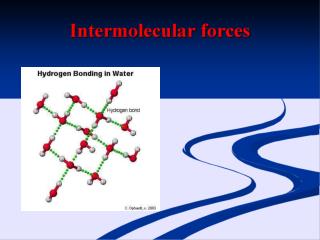
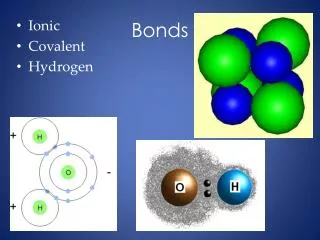
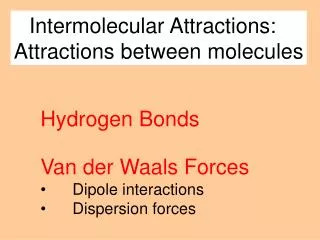
Hydrogen Bonds – • attraction between MOLECULES (NOT ATOMS!) that are both polar covalently bonded. • weakest of all chemical bonds • Very important for LIFE. • Responsible for unique properties of: • Water • Structure of proteins • Shape of DNA
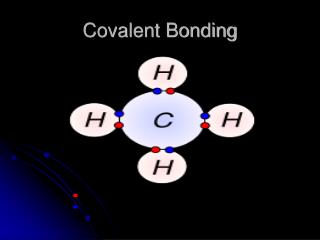
4. Polyatomic ions – • Covalently bonded atoms that have either lost or gained electrons • generally contain one or more elements combined with oxygen • most end in suffix -ate or –ite • most compound we use such as baking soda, soaps, cleaners • in formulas they are often shown in parenthesis to remind that they act as single ion • Ex: Ammonium sulfate (NH4)2SO4
D. Chemical Reactions – process by which chemical changes occur 1. Parts: “yields” Reactants Products
2. Balancing Equations Account for the Conservation of Mass! atoms on each side of equation must match in number Cannot change the formulas – must leave the subscripts alone! Only can place numbers (coefficients) in front of the formulas Coefficients of 1 are assumed and do not appear in balanced equation. when done, CHECK each element to verify
Ex: ____ P4 + ____ Br2 ____ PBr3 _1__ P4 + _6__ Br2_4__ PBr3
Ex: ____ Mn + ____ HI ____ H2 + ____ MnI3 2 Mn + 6 HI 3 H2 + 2 MnI3
Ex: ____ HBr + ____ Mg(OH)2 ____ MgBr2 + ____ H2O 2 HBr + 1 Mg(OH)21 MgBr2 + 2 H2O