Advances in Electron Cloud Buildup Observations and Measurements
This summary highlights key findings from the ECLOUD'07 conference held in Daegu, Korea, focused on electron cloud buildup in accelerator physics. Key advancements in measurements from various facilities like FNAL, KEKB, and RHIC are discussed. The significance of secondary electron yield (SEY) in influencing electron cloud dynamics is emphasized, alongside the impacts of chamber design and surface materials. Understanding conditioning mechanisms, such as "graphitization," is vital for mitigating electron cloud effects. Key challenges in self-consistent simulations and their effects on beam stability are also noted.

Advances in Electron Cloud Buildup Observations and Measurements
E N D
Presentation Transcript
Electron-Cloud Buildup: Summary Miguel Furman LBNL ECLOUD’07 Daegu, April 9-12, 2007
Disclaimer • This is not a comprehensive review of the talks • Rather, items that I found especially noticeable • My apologies if I don’t mention your contribution
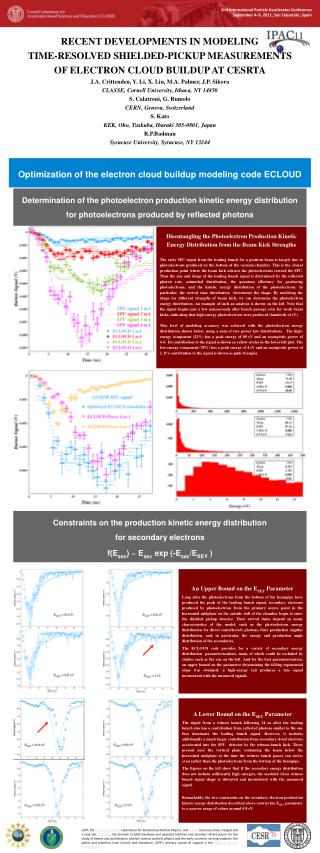
New and/or improved measurements • Ecloud now seen everywhere (may need searching) • FNAL Main Injector (MI) and Tevatron (R. Zwaska) • RFA measurements • CESR (M. Palmer) • HCX (M. Kireeff Covo, A. Molvik) • KEKB (J. Flanagan, M. Tobiyama, K. I. Kanazawa, S. Kato, M. Nishiwaki, M. Tobiyama, H. Jin, T. Ieiri) • SNS (S. Cousineau) • But not for nominal op. conditions • BEPC (Y. D. Liu) • RHIC (W. Fischer, SY Zhang) • e– flux correlated with P rise (P rise mostly due to e– desorption) • ANKA cold undulator, Bw=0 (S. Casalbuoni) • e– suspected but not conclusively implicated in heat load • PSR quads (R. Macek) • Swept electrons decay constant ~60-90 ms • Suspect significant primary electrons from beam scraping quads, then electrons ExB drift to neighboring field-free regions • Support from ORBIT code simul. (Y. Sato)
Basics • Ecloud buildup is a local issue • Chamber properties (geometrical, electronic) are important • Seed (primary) electrons may be important, and may have strong local fluctuations • Effects on the beam (instabil., e growth) are global • In most cases, ecloud buildup dominated by SEY d(E) • Strong nonlinear amplification of e– density de if deff > 1 • Most of this summary talk is centered on the SEY theme
SEY • Impressive progress at KEK (S. Kato, M. Nishiwaki) • Several materials • XPS analysis • e– bombardment at energy 5 keV, also 500 eV • All lead to dmax≈1 after e– bombardment, dose=0.1–1 C/cm2 !!! • Understanding of this conditioning mechanism: “graphitization” • Also measured conditioning due to ecloud in KEKB • similar results although dmax slightly >1 • In-situ SEY measurement essential • Would be nice to check conditioning by e– bombardment at 100 eV (this is more relevant to actual eclouds in accelerators) • Is graphitization seen eslewhere? (apparently not; M. Pivi, SLAC TiN conditioning) • Stainless steel sample measured: SS304; would be nice to check for SS316LN
SEY remaining issues • Relative composition of e– emission spectrum • True secondaries dts(E), rediffused dr(E) and elastically backscattered de(E) • Desirable to measure emission spectrum and disentangle the 3 components • Complication: the measurement itself conditions the surface • How do these 3 components condition under e– bombardment? (probably not at the same rate) • Importance: dr(E) can have significant effect on ecloud buildup for large bunch spacing (eg., LHC) • Limit of d(E) when E<~10 eV: • Cimino-Collins: d(0)=1 for cold Cu (Appl. Surf. Sci. 235, 231 (2004)) • Most measurements (and buildup simul.) have d(0)=0.3-0.6 • d(0) controls the dissipation of the ecloud • d(0)=1 has significant adverse effect on buildup
More on SEY • Grooved surface chambers • All indications are that effective SEY significantly lower than for flat surface • Recent PEP-II tests disappointing owing to confusion from photoelectrons • But little doubt that grooves decrease effective SEY • Clearing electrodes • Straightforward mechanism to reduce ecloud density • The devil is in the details: reliability, durability, impedance, % coverage of the circumference • Clearing electrodes based on enamel coatings (CERN) • what is enamel SEY? • The devil is in the details
Simulations • Significant effort on ILC DR for some time now (M. Pivi) • Interesting that these simulations have influenced design decisions • Investigation at CESR-TA (M. Palmer) • Presently looking for 3D effects in ILC DR wigglers (C. Celata) • Self-consistency will come later, in stages • FNAL MI simulations (M. F.) point to dmax=1.3-1.5 • But direct sample measurement at SLAC says dmax=2 • Was sample contaminated in the trip from FNAL to SLAC ? • Emphasis nowadays is on ecloud effects on beam • Rightfully so • Assume de and see what it does to the beam • Fully self-consistent (“FSC”) simulation is formidable with current codes and computers • Large disparity of time scales, mixes “s” and “t” descriptions, possibly brings in large length scales (ORBIT; S. Cousineau) • Hope for FSC simulations: Lorentz boosted frame calculations (J. L. Vay)
Simulation issues at high SEY • Virtual cathode formation: how much is real, how much numerical? • We do see them sometimes in simulations • Image forces of macroelectrons near wall can be too large local multipacting in the absence of beam • Dependence of SEY on applied E-field (from sp. charge) not included • Macroelectron phase space “culling” algorithm needs improvement • No. of macroelectrons Me can grow dramatically need to throw some away every once in a while • Correct solution: depopulate the macroelectron distribution while preserving the 6D physical e– phase space distribution • too slow (but parallelizable, so maybe OK) • Simplest solution (discard macroelectrons randomly) can lead to large numerical fluctuations owing to wide range of macroelectron charges • BTW, algorithms with fixed Me have the same problem (wide range of macroelectron charges)
Puzzle • If dmax1 is so readily achieved by electron conditioning (new KEK results), why is ecloud still a significant operational problem in many machines? • I don’t think primary electrons are sufficient to explain problem (except possibly at KEKB: lots of photoelectrons, and PEP-II in the straights (?)) • Here are some possibilities: • Lots of electrons trapped in quads (PSR, KEKB, SPS,…?) • dmax is smaller than we think (1) but d(0) is higher than we think (also 1) • Problem: PSR swept electron signal decay in field-free regions points to d(E)0.5 at low E; but maybe does not contradict d(0)=1 • In fact, an upturn in d(E) as E0 might explain why signal decay is slower than exponential • Hadron storage rings are not as well conditioned as e+ storage rings because electron-wall impact energy is lower in the former than in the latter (for a given bunch intensity) • Additional reason to investigate e– dose conditioning at E<100 eV • My jet lag • Other …
Acknowledgments • I am indebted to C. Celata, K. Harkay, R. Macek, M. Pivi, K. Sonnad, J.-L. Vay, R. Zwaska and other participants for discussions • I am grateful to the ECLOUD’07 local organizers especially Eun San Kim Kazuhito Ohmi Hitoshi Fukuma for such a pleasant and productive workshop!