Indicators and pH
This experiment aims to teach the concepts of pH, acids, and bases through the use of indicators. Acids are characterized by a high concentration of hydronium ions (H3O+), while bases have a high concentration of hydroxyl ions (OH-). The pH scale ranges from 0 to 14, with 7 being neutral. Various indicators like litmus paper and phenolphthalein are used to observe color changes in acidic and basic solutions. Follow the procedures to test hydrochloric acid (HCl) and sodium hydroxide (NaOH) to record how these substances affect indicators.

Indicators and pH
E N D
Presentation Transcript
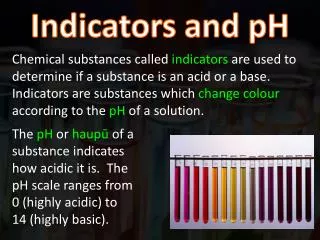
Indicators and pH Objective: To learn about pH and how indicators show a substance to be an acid or a base.
Research: • Acid: solutions – high concentration of H3O+ ions. Hydronium • Base: solutions – high concentration of OH- ions. Hydroxyl • pH: percent of hydrogen – how acidic it is.
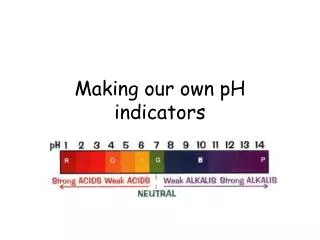
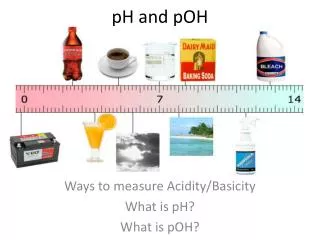
pH scale: series of numbers 0-14. 7= neutral, 0-6 acid, 8-14 base. • Indicator: substance that shows a definite color change when mixed with acid or base.
Effect on AcidsEffect on Bases • Blue litmus paper: pink___ • Red litmus paper: ___ blue • Phenolphthalein: stays clearshocking pink • Bromthymol blue: orange ___ • Congo red: blue ___ • As the pH of a solution changes, the indicator shows a specific color change.
Procedure I – AcidAfter each step, record your observations. • Drop a small drop of HCl onto blue litmus paper. • Drop a small drop of HCl onto red litmus paper. • Place a small amount of HCl into test tube A.Add 1 drop of phenolphthalein. Rinse TT. • Place a small amount of HCl into test tube A.Add 2 drops of bromthymol blue. Rinse TT. • Place a small amount of HCl into test tube A.Add 1 drop of congo red. Rinse TT.
Procedure II – BaseAfter each step, record your observations. • Drop a small drop of NaOH onto blue litmus paper. • Drop a small drop of NaOH onto red litmus paper. • Place a small amount of NaOH into test tube B.Add 1 drop of phenolphthalein. Rinse TT. • Place a small amount of NaOH into test tube B.Add 1 drop of bromthymol blue. Rinse TT. • Place a small amount of NaOH into test tube B.Add 1 drop of congo red. Rinse TT.