Measuring pH Levels Using Natural Cabbage Indicators from Household Items
120 likes | 271 Vues
This lab experiment focuses on measuring the pH levels of various household items utilizing a natural pH indicator derived from red cabbage leaves. By creating a cabbage extract, students can visually interpret the pH scale and learn to identify acidic, neutral, and basic substances. The procedure includes preparing the indicator, testing common items like vinegar, baking soda, and toothpaste, and analyzing the color changes to classify each substance according to its pH level. This hands-on activity fosters a better understanding of the pH scale and the science behind acid-base reactions.


Measuring pH Levels Using Natural Cabbage Indicators from Household Items
E N D
Presentation Transcript
Identifying pH Using Natural Sources as Indicators La’Darion Roberts Period 3 LaSalle
Purpose • The Purpose of this lab is to measure the pH of Various household items using a natural indicator prepared from Cabbage Leaves. This demonstration will help with understanding the readings of a pH scale, and how to use indicators to determine the pH of a substance.
What you will need… • • knife • • red cabbage leaves • • 1-cup measure • • hot water • • 2 jars • • clean white cloth • • teaspoon • • tape • • 3 sheets of plain white paper • • pencil • • ruler • • 10 clear plastic cups • • white vinegar (CH3COOH) • • baking soda (NaHCO3) • • household ammonia • • dropper • • various household items
Procedures • Put ½ cup of finely chopped red cabbage leaves in a jar and add ½ cup of hot water. Stir and crush the leaves with a spoon. Continue the extraction until the water is distinctly colored. • Strain the extract through a piece of cloth into a clean jar. This liquid is your natural indicator.
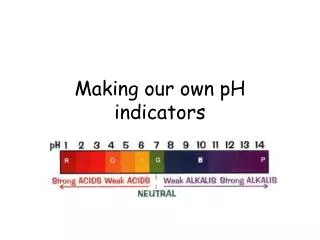
Procedure • Tape three sheets of paper end to end. Draw a line along the center and label it at 5 cm intervals with the numbers 1 to 14. This is your pH scale. • Pour your indicator to about 1 cm depth into each of three plastic cups. To one cup, add several drops of vinegar
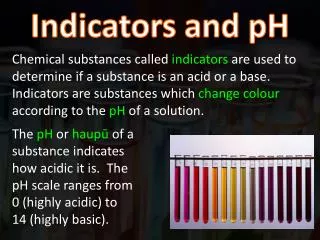
Procedure • to the second add a pinch of baking soda, • and to the third add several drops of ammonia. • ***The resulting colors indicate pH values of about 3, 9, and 11, respectively. Place these colored positions on your pH scale.
Procedure • Repeat Step 4 for household items: Lemon Juice, 2% Milk, Coffee, Mouthwash, Toothpaste, distilled water, laundry detergent(powder), dish washing soap
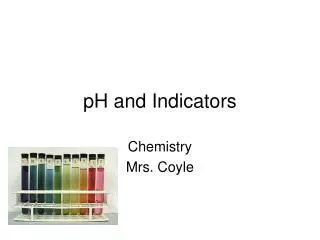
Analysis and Conclude • What was the color of the indicator at acidic, neutral, and basic conditions? • The color of the indicator changed to a light pink/red and color when an acidic substance was added, it remained the same/turned lighter for the neutral(distilled water) and turned a deep green/blue for the basic. These colors closely resembled the colors on the pH scale.
Analysis and Conclude • What chemical changes were responsible for the color changes? • The color changes occurred because each substance had a different concentration of [H+] and [OH-] ions, therefore causing the pH to be higher(basic) or Lower(acidic)
Analysis and Conclude • Label the materials you tested as acidic, basic, or neutral. • Baking Soda- Acidic • Ammonia- Basic • Vinegar- basic • Milk- acidic • Lemon juice- acidic • Coffee- acidic • Water- neutral • Dish soap- basic • Mouth wash- Acidic • Toothpaste- Acidic • Laundry detergent- basic
Analysis and conclude • Which group contains items used for cleaning or for personal hygiene? • During the experiment, I noticed that the items used for cleaning are almost always Basic solutions, and the ones that we use for personal hygiene, (i.e. mouthwash, toothpaste, etc) are almost always acidic!