Huff Hartz Research Group
This research explores the aerosol yields from a mixture of biogenic precursors and assesses whether smog chamber experiments accurately replicate atmospheric conditions. Focused on essential oils, the study utilizes advanced techniques like Solid-Phase Microextraction and Gas Chromatography-Mass Spectrometry to analyze oxidation products. The experimental setup includes an environmental chamber with an ozone generator and various organic compounds, including a-pinene and limonene. The findings aim to enhance the understanding of atmospheric emissions and their impacts on air quality.

Huff Hartz Research Group
E N D
Presentation Transcript
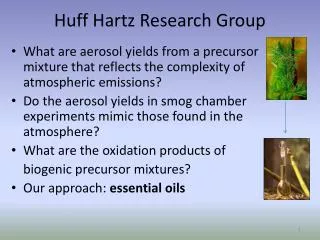
Huff Hartz Research Group • What are aerosol yields from a precursor mixture that reflects the complexity of atmospheric emissions? • Do the aerosol yields in smog chamber experiments mimic those found in the atmosphere? • What are the oxidation products of biogenic precursor mixtures? • Our approach: essential oils
SIUC Environmental Chamber Air Filtration System Headspace SPME Ozone Monitor Injection Port FilterSamples 5 m3 Teflon Chamber Ozone Generator IS Solid-Phase Microextraction a-pinene SOA extract Ion trap GCMS IS blank Scanning Mobility Particle Sizer
SOA from Siberian Fir Needle Oil a-pinene bornyl acetate camphene 3-carene limonene terpinolene b-pinene a-terpineol borneol bornyl acetate camphene b-caryophyllene 3-carene a-pinene borneol limonene Total Ion Count humulene terpinolene b-pinene a-terpineol Yield = 0.42 borneol C15H24 If we apply the two- component model of Presto et al.: Yield = 0.32 Time, min.