Exploring Lunar Phases and Eclipses in Astronomy
This lecture by Professor Lee Carkner delves into the significant contributions of renowned astronomers Tycho Brahe, Johannes Kepler, and Galileo Galilei to planetary science. It explores fundamental concepts of lunar observations, including the phases of the Moon, eclipse mechanics, and the differences between sidereal and synodic months. The lecture further discusses the geometry of lunar and solar eclipses, types of eclipses, and patterns. Ideal for astronomy enthusiasts, this session provides a comprehensive overview of celestial movements and their historical implications.

Exploring Lunar Phases and Eclipses in Astronomy
E N D
Presentation Transcript
Observing the Moon and Eclipses Astronomy 311 Professor Lee Carkner Lecture 4
What were the most important contributions to planetary science of Tycho, Kepler, and Galileo respectively? • Observing with a telescope, Determining the laws of planetary motion, Measuring the motions of the planets • Determining the laws of planetary motion, Observing with a telescope, Measuring the motions of the planets, • Observing with a telescope, Measuring the motions of the planets, Determining the laws of planetary motion • Measuring the motions of the planets, Determining the laws of planetary motion, Observing with a telescope • Measuring the motions of the planets, Observing with a telescope, Determining the laws of planetary motion
What period in history saw the greatest increase in our understanding of the physical properties of the solar system? • 200 BC – 200 AD • 1550 AD -1650 AD • 1650 AD – 1800 AD • 1900 AD – 1950 AD • 1950 AD – 2000 AD
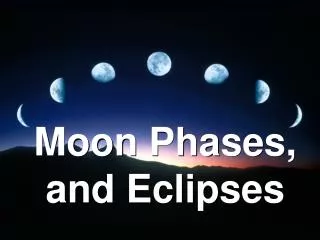
Moon Basics • Shows 1 complete set of phases in one month • Phase is determined by how much of the lit side we can see
New -- Quarter -- see 1/2 illuminated side Full -- Crescent -- Gibbous -- more than 1/2 of illuminated side Waxing -- Waning -- decreasing brightness
Sidereal and Synodic • Sidereal period -- time for moon to return to initial position with respect to the stars (27.3 days) • Synodic period -- time for moon to return to initial position with respect to the sun (29.5 days)
Where is the Moon? • Since the moon makes one orbit in about 30 days, it moves 1/30 of a complete circle in the sky in one day • Moon is ~12 degrees further east each night
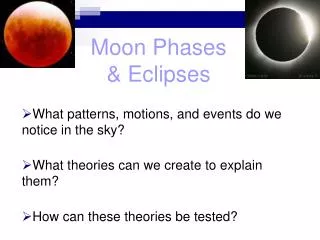
Eclipses • Solar Eclipse • Happens during New moon • Lunar Eclipse • Happens during Full moon
When do Eclipses Happen? • Moon’s orbit is tilted by about 5 degrees with respect to the ecliptic (plane of the Sun and Earth) • Only have eclipses when Sun falls on line of nodes (line where the orbital plane of the Earth and Moon intersect)
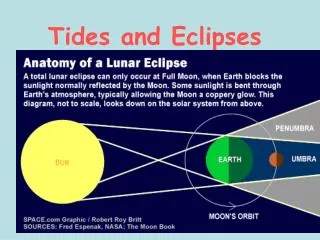
Shadows on the Moon • Umbra -- Darkest part of the shadow • Penumbra -- Less dark part of shadow, region is still getting some sunlight • Penumbral eclipses can be hard to notice
Types of Lunar Eclipses • Total Eclipse -- Moon is completely covered • Partial -- Moon is partially covered • Penumbral -- • You can still faintly see the Moon even during a total lunar eclipse because of scattered light (circular sunset)
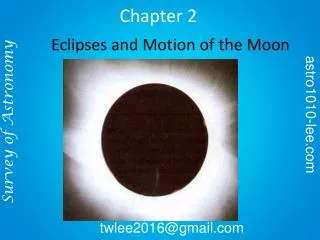
Types of Solar Eclipses • Total Eclipse -- Sun is completely covered • Partial -- Sun is partially covered
Annular Eclipse • Moon is about 400 times smaller than the Sun, but is also about 400 times closer • When the Moon is the furthest from the Earth it does not completely cover the Sun • Annular Eclipse --
Next Eclipses • Eclipses visible from central U.S. • Lunar – • Total solar eclipse – August 21, 2017 • For any given location, you see many more lunar than solar eclipses
Next Time • Read chapter 2.5-2.8 for next time
Summary • Orbit • one complete orbit in one sidereal month • same side always faces the Earth • Phases • complete set in one synodic month • where the Moon is in sky at a particular time depends on the phase
Eclipses • caused by Earth or Moon blocking out the Sun • only occur when line of nodes points at Sun • are darkest when in the umbra • occur in cycles