Engaging Starters: Enhancing Classroom Dynamics and Teaching Practices
This lesson focuses on the critical role of starters in the classroom, showcasing common challenges and effective solutions. Participants will engage in group discussions to identify reasons for chaotic starts and collaborative strategies to improve them. Key objectives include understanding what constitutes an effective starter and recognizing its importance in engaging students. By the end of the session, educators will be equipped with practical insights and best practices to implement stimulating starters, fostering active participation and better learning outcomes.

Engaging Starters: Enhancing Classroom Dynamics and Teaching Practices
E N D
Presentation Transcript
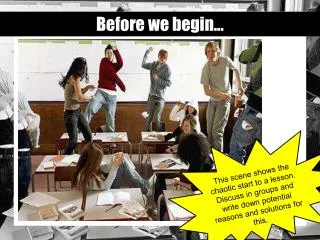
Before we begin... This scene shows the chaotic start to a lesson. Discuss in groups and write down potential reasons and solutions for this.
Objectives... • To discuss the importance of using starters and share good teaching practice. Outcomes... • All will know what makes a good starter. • Excellent when you are able to recognise the importance of using engaging starters. • Even better if you share good teaching practice.
Theory... ‘Brisk, whole-class interactive teaching that provide lively introductions’ • They encourage early levels of engagement and motivation. • They help to inject a sense of pace and challenge • They create an expectation that pupils will think and participate in the lesson. • Starters can be used to: • Prepare for new learning • Revisit and practice important skills • Consolidate knowledge from or make links to previous lessons • Assist memory Write down your 3 things you have found out • They need to be... • Immediately accessible • Hook pupils interest (mystery, curiosity, novelty and relevance) there should always be an element of fun • Possible pitfalls: • The starter takes too long • It takes over the whole of the lesson • They starter can lose pace and direction • They can become a fixed and stagnant routine • They can be derailed by wayward responses
Main task... • Open the envelope and follow the instructions.
Reflection... • Complete the learning triangle: One thing you hope to use in your teaching tomorrow. Two things you are going to take away from this session. Three features of a successful starter.
Objectives... • To discuss the importance of using starters and share good teaching practice. Outcomes... • All will know what makes a good starter. • Excellent when you are able to recognise the importance of using engaging starters. • Even better if you share good teaching practice.