What does DNA do?
DNA plays a crucial role in protein synthesis, acting as a template for the creation of proteins that are essential organic molecules in living organisms. Proteins are made from amino acids, which are linked together in specific sequences determined by genes encoded in DNA. During transcription, a gene unwinds and is used to create a complementary mRNA strand that specifies the order of amino acids. In the translation process, ribosomes read the mRNA and assemble the amino acids into proteins. Thus, DNA is vital for producing the proteins necessary for life.

What does DNA do?
E N D
Presentation Transcript
Make Proteins! • Proteins are important organic molecules • See. p. 186 • Why are proteins soimportant?
Proteins… • are complex molecules • are made of lots of smaller units called amino acids
are made in the cell by cell organelles called ribosomes • every protein is made of a specific sequence of amino acids
Amino Acids • amino acids are the small units that proteins are made of • there are 20 amino acids • amino acids are found n the cytoplasm and nucleus of cells
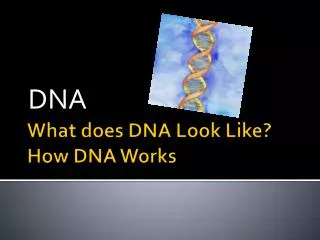
Amino acids and DNA • DNA is a complex molecule consisting of nucelotides • the nucleotides contain bases, sugars and phosphates
bases are the “rungs” • the sugars and phosphates are the sides
a codon is a set of three bases that will produce a particular amino acid
Where do genes fit in? • A gene is a section of DNA that gives the instructions to make a specific protein (such as enzymes, hormones, haemoglobin, etc.)
A gene is therefore the set of codons designed to make a sequence of amino acids (which is a protein)
So…. • DNA is therefore responsible for the making of proteins! • How does this happen???
Transcription • in the nucleus of a cell, a section of the DNA (a gene!) unwinds a bit at a time • extra DNA components are “fed into” the unwound bit, creating a single, complementary strand called mRNA • in mRNA T’s are replaced with U’s • this mRNA is the template or instructions for the cell to make a specific protein
Translation • the mRNA works its way out of the nucleus into the cell • cool little protein making “devices” called ribosomes attach to the mRNA and use it to link up amino acids in the particular order as specified by the bases • this creates a protein molecule