Download
1 / 15
150 likes | 281 Vues
This guide explores the fundamental aspects of weather, driven by solar heat and water phase changes. It covers day-to-day atmospheric conditions, including air temperature, humidity, precipitation, air pressure, wind speed and direction, and cloud coverage. The United States hosts a remarkable variety of weather phenomena linked to air masses, fronts, and pressure zones. Learn about different types of fronts—warm, cold, and occluded—and their associated weather patterns, as well as the dynamics of low and high-pressure systems, including severe weather events like hurricanes and tornadoes.

E N D
Weather • Day to day conditions of the atmosphere • driven by the heat from the sun and fueled by the energy of water phase changes • The weather is expressed in terms of its elements: air temp, humidity, precipitation, air pressure, speed and direction of wind, cloud coverage
Changes in the weather • The US has the greatest variety of weather of any country in the world! • Associated with fronts, pressure zones, and air masses • What is an air mass?
Warm Front • Marked on a map by a red line with red semi-circles pointed towards the cool air • Generally associated with cirrus clouds followed by stratus/nimbostratus type clouds, (overcast skies), drizzle
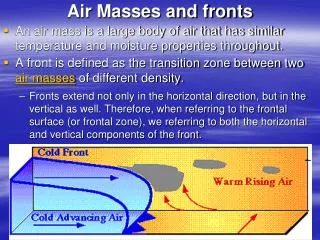
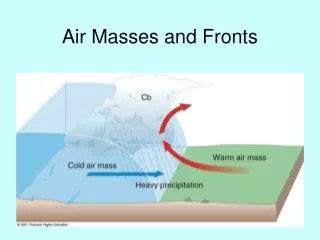
Cold Front • Marked on a map with a blue line and blue triangles pointing towards the warm air. • cumulonimbus clouds along the front in the warm air, producing thunderstorms/heavy precipitation as well as severe weather at times (hail, tornados)
Occluded Front Note: Warm air gets wedged between the cooler air causes clouds to form
Lows and Highs • High pressure=air falling=clear skies, clockwise rotation • Low pressure caused by lifting air • Low pressure centers=“storm”, characterized by counterclockwise rotation of wind, cloudiness, precipitation • Hurricane, mid-latitude cyclone, tornado
Practice Questions What is North Carolina experiencing in terms of type of clouds based on this weather map?