Download
1 / 24
240 likes | 363 Vues
This study investigates the effectiveness of turbidity and streamflow as methods to estimate suspended sediment concentrations (SSC) in three Chesapeake Bay tributaries, namely the James, Rappahannock, and Northern Shenandoah Rivers. It aims to evaluate turbidity as a surrogate for SSC in sediment and nutrient estimations, and compares the accuracy and precision of two regression models. Findings indicate that turbidity-based models can yield more reliable estimates with reduced uncertainty, offering a valuable methodology for improving sediment monitoring and nutrient management in freshwater systems.

E N D
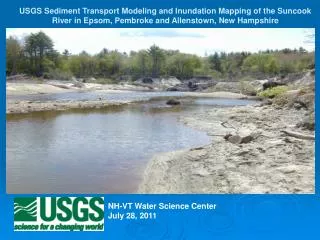
A Comparison of Turbidity-Based and Streamflow-Based Estimates of Suspended-Sediment Concentrations in Three Chesapeake Bay Tributaries John Jastram Virginia Water Science Center
Background • Streamflow has been used as a surrogate to estimate fluvial sediment transport for over a half century (Campbell and Bauder, 1940). • Improved streamflow-based models (ESTIMATOR) have traditionally been used to estimate sediment and nutrient loadings to the Bay. • Variability in relation between streamflow and constituent concentrations leads to large uncertainty terms. • Turbidity has been recognized as an effective sediment surrogate for decades (Walling, 1977). • Recent technological advances have enabled the in-situ measurement of turbidity at high temporal resolution. • CBP funded a study of the effectiveness of turbidity-based SSC estimation in Bay tributaries.
Study Objectives * Objectives were expanded to include nutrient estimates Evaluate the use of turbidity as a surrogate for estimating SSC in the James, Rappahannock, and N.F. Shenandoah Rivers. Compare two methods of estimating SSC: turbidity-based and streamflow-based regression models.
Approach Data Collection • Continuous water-quality monitoring • Water Temperature • Specific Conductance • pH • Turbidity • Sediment and Nutrient Sampling • Scheduled Monthly • Storm Events
Approach Data Analysis • Generate site-specific turbidity-based multiple regression models. • Generate site-specific streamflow-based multiple regression models (ESTIMATOR). • Compare quality of estimates from each method • Accuracy and precision of estimates
Turbidity-Based Regressions • Multiple Linear Regression • Transformed Variables • Natural Logarithm • Square Root • Best Subsets Regression • Mallows CP, PRESS, Adj. R2 • Partial Residual Plots • Transformation Bias Correction
Streamflow-Based Regressions • Multiple Regression Model (ESTIMATOR) • Explanatory variables: • Streamflow • Time • Seasonality • Calibration Datasets • Two models generated per site using: • 9-year window • Typically used for Bay tributaries • To allow overall comparison of approaches • Study period • Same data window used for turbidity-based models • To allow direct comparison to turbidity-based models
Comparison of Models • Comparison of accuracy and precision of concentration estimates from each method. • Hypothesis tests • Squared-ranks Tests for homogeneity of variance • Are the variances of the streamflow-based estimates greater than those of the turbidity-based estimates? • Estimated Concentrations • Residuals • Comparison of error statistics for concentration and instantaneous load estimates • MSE • SSE • MAE • Graphical evaluation of observed and estimated concentrations
James River n = 69 Continuous Data & Sample Data Rappahannock River n = 50 Discrete samples collected to adequately characterize the range of observed conditions NF Shenandoah River n = 27
Observed vs. Estimated SSC James River NF Shenandoah River Rappahannock River
Distributions of Residuals James River Rappahannock River NF Shenandoah River
Squared-Ranks Tests • Tests for homogeneity of variance • Estimated Concentrations • Residual • H0 = Variance Streamflow-based > Variance Turbidity-based
Comparison of Error Statistics Error statistics for estimated concentrations and instantaneous loads
Effect on Summed Loads James River at Cartersville • Loads generated using LN transformed models in LOADEST • Greatly reduced width of 95% confidence intervals. • Critical improvement to enable change detection.
Transfer to Nutrient Estimations - TP James River Rappahannock River
Transfer to Nutrient Estimations - TN James River Rappahannock River
Further Potential Computed Suspended Sediment Concentration Computed Suspended Sediment Load Discharge, cfs http://nrtwq.usgs.gov Realtime instantaneous concentration and load estimates.
Challenges & Limitations • Data Collection • Sensor Fouling • Missing data • Sensor Deployment • Data Analysis • Missing Data • Tools for load estimation • High temporal resolution • Data Transformations • Uncertainty of summed loads
Conclusions • Use of continuous water-quality data as a surrogate for sediment and nutrients is a viable approach in Bay tributaries. • Turbidity-based estimation models can provide estimates of concentration and load with less uncertainty than the typically applied streamflow-based methods. • Limitations of data analysis procedures need to be resolved to support temporally dense datasets and alternate transformations.
Significance and Potential Benefits • Methodology has been developed to generate load data with increased accuracy and precision • Facilitates change detection • Adoption of this approach could result in • Immediate improvements in data quality • Improved ability to detect change • Long term reductions in sample collection needs
Additional Turbidity/Surrogate Studies by VA WSC • Indian Creek Pipeline Monitoring • SIR 2009-5085 (Hyer and Moyer) • South River Mercury • SIR 2009-5076 (Eggleston) • Roanoke River Flood Reduction Project • Masters Thesis (Jastram, 2007) • JEQ Article (Jastram, Hyer, and others, 2010) • SIR (≈2012) • Fairfax County Watershed Study • Difficult Run Executive Order • Smith Creek • Executive Order
John JastramDoug MoyerKen Hyer http://pubs.usgs.gov/sir/2009/5165/