Circular Motion: Understanding Kepler's Laws
270 likes | 359 Vues
Learn about Kepler's Laws, circular motion, and universal gravitation. Explore historical views of the universe from Aristotle to Copernicus and Kepler. Practice calculations and review Newton's Law of Universal Gravitation. Prepare for upcoming quizzes, tests, and assignments in physics class.


Circular Motion: Understanding Kepler's Laws
E N D
Presentation Transcript
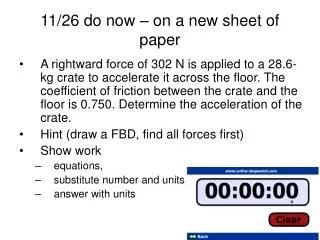
Do Now (on a new sheet please): • What net force must act on a 5 kg mass that is moving at a constant speed of 4 m/s around a circle with a radius of 2 m?
Objective/Homework • Objective: • Homework: • Circular Motion – due Tuesday 12/14 • Quiz: Circular Motion – Tuesday 12/14 • Lab: Circular Motion – Friday 12/17 • Kepler’s Laws Worksheet: Monday 12/20 • Test: 2-D Motion – Tuesday December 12/21
Do Now (12/19): • What are the three views of the universe that changed over time? • Who are the men who developed each? • Which is our current view?
History of Views of the Universe Aristotle: Geocentric (everything rotates around the Earth in perfect circles) • Patterns of stars in the sky never change • Planets drift with respect to background stars
History of Views of the Universe Nicolas Copernicus: Heliocentric (everything rotates around the sun in perfect circles) • Accurately predicts the rising and setting Sun, moon, and stars • Accounts for retrograde motion of Mars, Jupiter, and Saturn
History of Views of the Universe Johannes Keplar: Heliocentric • Used the accurate recorded observations of Tyco Brahe to develop a new planetary model and three laws • Planets rotate around the sun in ellipses with the sun at one focus
Keplar’s Laws • First law: The path of each planet about the sun is an ellipse with the sun at one focus
Keplar’s Laws • Second Law: Each planet moves so that the planet sweeps out equal areas in equal periods of time • http://www.physicsclassroom.com/mmedia/circmot/ksl.cfm
Keplar’s Laws • Third Law: The ratio of the squares of the periods (time of rotation: T) of any two planets revolving around the sun is equal to the ratio of the cubes of their radius R from the sun
Variables and constants: • T=period of orbit • R or r= radius of orbit • G=universal gravitational ; G= 6.67x10⁻¹¹ Nm2/kg2 • m=mass • F= force • K=Kepler’s constant
Newton’s Law of Universal Gravitation • Fg = force of gravity • G = 6.67x10⁻¹¹Nm2/kg2 • r = distance between two objects • m = mass 1 or 2
Practice/Review: • Please use the rest of class to work on “Kepler’s Laws and Universal Gravitation.” Make sure your test trial results are in by the end of the day!!!
Example: • A 3 kg mass and a 2 kg mass are placed with their centers 5 m apart. What is the force of attraction between them?
Do Now: • A 5 kg mass and a 6 kg mass are placed with their centers 0.5 m apart. What is the force of attraction between them? • Turn in your Circular Motion worksheet and your Do Now’s from last week (starting with 12/6)
Quiz: • Clear your desks except for a piece of paper and a writing utensil
Quiz: • A 9800 N car is driven on a circular track with a diameter of 600 m at 30 m/s. Calculate the car’s centripetal acceleration & its centripetal force.
Do Now (12/20): • A 5 kg mass and a 6 kg mass are placed with their centers 0.5 m apart. What is the force of gravitational attraction between them?
Law of Universal Gravitation: The gravitational force between two objects
Period of a planet orbiting the sun • ms: the mass of the sun (constant) • r: radius of orbit
Speed of a satellite orbiting earth • me= mass of the earth • r=radius of orbit
Period of a satellite orbiting the earth • r=radius of orbit
Practice/Review: • Please use the rest of class to work on “2-D Forces Review.” Make sure your test trial results are in!!! Once you finish, you may work on your notecard for tomorrow’s test.
Do Now: • What is the speed of the planet Jupiter around the sun? • hint – look on page 178 of your classroom textbooks • Hint – look for the radius of the ORBIT not the radius of the planet
Do Now: • What is the period of the planet Neptune around the sun? • hint – look on page 178 of your classroom textbooks