

SlideServe
Menu
Préférences
© SlideServe · v2026

Learning Theories

dillan avatar
22 diapositives · 431 Views · Jul 26, 2014

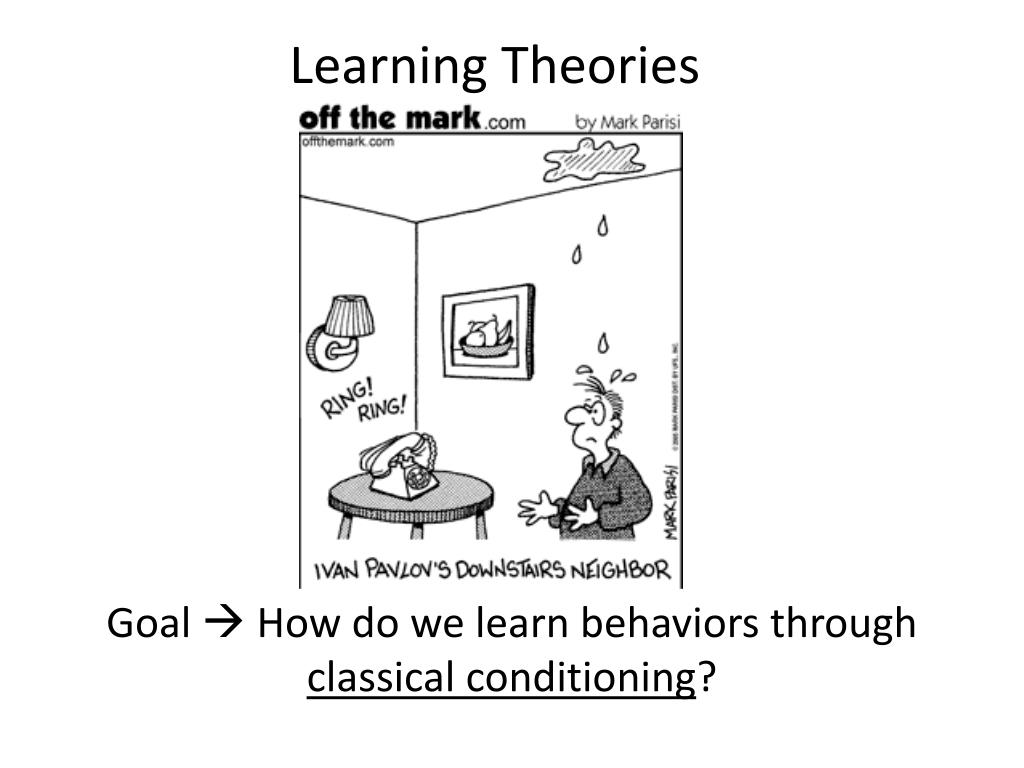
Learning Theories. Goal  How do we learn behaviors through classical conditioning ?. Learning is…. Relatively permanent Change in behavior Due to experience. Habituation. Associative Learning. Learn that certain events occur together.
Learning Theories - slide 1
01 / 22Learning Theories
1 / 17

Télécharger la présentation

Learning Theories
Une image / un lien ci-dessous est fourni (tel quel) pour télécharger la présentation

Politique de téléchargement : le contenu du site vous est fourni TEL QUEL pour votre information et votre usage personnel ; il ne peut être vendu, concédé sous licence ni partagé sur d’autres sites sans l’accord de son auteur.Le contenu vous est fourni TEL QUEL, pour votre information et votre usage personnel uniquement. Téléchargez la présentation en cliquant sur ce lien. Lors du téléchargement, si vous ne parvenez pas à télécharger une présentation, l’éditeur a peut-être supprimé le fichier de son serveur.Pendant le téléchargement, si vous ne parvenez pas à obtenir une présentation, le fichier a peut-être été supprimé par l’éditeur.

F I N

Plus de contenu associé

Transcription de la présentation
  1. Learning Theories Goal  How do we learn behaviors through classical conditioning?

  2. Learning is… • Relatively permanent • Change in behavior • Due to experience

  3. Habituation

  4. Associative Learning • Learn that certain events occur together Classical Conditioning: associate two stimuli together to anticipate events Operant Conditioning: associate a behavior with a good or bad result

  5. Ivan Pavlov’s Experiment • Studied digestion of dogs • Learn to salivate? • Paired food w/neutral stimulus • Dogs salivated to just the neutral stimulus

  6. Pavlov’s Experiment

  7. UR • UC • CR • CS

  8. Classical Conditioning

  9. Acquisition (CS+UCS) Strength of CR Spontaneous recovery of CR Extinction (CS alone) Extinction (CS alone) Pause Classical Conditioning

  10. Extinction

  11. John B. Watson & “Little Albert” http://www.youtube.com/watch?v=KxKfpKQzow8&feature=related

  12. Generalization = • Discrimination

  13. Generalization

  14. Taste Aversion UC UR CS CR

  15. Factors Influencing Classical Conditioning 1) How consistently CS predicts UCS 2) Number of pairings of CS and UCS 3) Intensity of UCS 4) Time between CS and UCS

  16. Higher-OrderConditioning = = =

  17. But what about…? • Cognitive processes? • Learned helplessness • Biological predispositions? • Garcia & Koelling study  associations may be adaptive