Reversible Assembly of Microparticles at Liquid Crystal Interfaces for Tunable Material Properties
10 likes | 131 Vues
This study explores the reversible assembly of solid microparticles at the interfaces between nematic liquid crystals and aqueous phases. Utilizing sedimentation, microparticles are deposited to achieve controlled interparticle spacing and organization. The introduction of a molecular surfactant induces an ordering transition in the liquid crystal, prompting a reorganizational shift in the microparticles from chains to two-dimensional arrays with hexagonal symmetry. This work highlights the potential for liquid crystals to facilitate reversible and chemosensitive control over interfacial particle organization, crucial for developing materials with tunable properties.


Reversible Assembly of Microparticles at Liquid Crystal Interfaces for Tunable Material Properties
E N D
Presentation Transcript
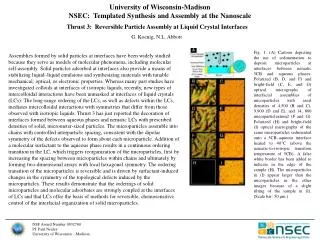
University of Wisconsin-MadisonNSEC: Templated Synthesis and Assembly at the Nanoscale Thrust 3: Reversible Particle Assembly at Liquid Crystal Interfaces G. Koenig, N.L. Abbott Fig. 1. (A) Cartoon depicting the use of sedimentation to deposit microparticles at interfaces between nematic 5CB and aqueous phases. Polarized (B, D, and F) and bright-field (C, E, and G) optical micrographs of interfacial assemblies of microparticles with areal densities of 4,500 (B and C), 9,900 (D and E), and 14; 800 microparticles∕mm2 (F and G). Polarized (H) and bright-field (I) optical micrographs of the same microparticles sedimented onto a 5CB–aqueous interface heated to 40°C (above the nematic-to-isotropic transition temperature of 5CB). A false white border has been added to indicate in the edge of the sample (H). The microparticles in (I) appear larger than the microparticles in the other images because of a slight tilting of the sample in (I). (Scale bar: 50 μm.) Assemblies formed by solid particles at interfaces have been widely studied because they serve as models of molecular phenomena, including molecular self-assembly. Solid particles adsorbed at interfaces also provide a means of stabilizing liquid–liquid emulsions and synthesizing materials with tunable mechanical, optical, or electronic properties. Whereas many past studies have investigated colloids at interfaces of isotropic liquids, recently, new types of intercolloidal interactions have been unmasked at interfaces of liquid crystals (LCs): The long-range ordering of the LCs, as well as defects within the LCs, mediates intercolloidal interactions with symmetries that differ from those observed with isotropic liquids. Thrust 3 has just reported the decoration of interfaces formed between aqueous phases and nematic LCs with prescribed densities of solid, micrometer-sized particles. The microparticles assemble into chains with controlled interparticle spacing, consistent with the dipolar symmetry of the defects observed to form about each microparticle. Addition of a molecular surfactant to the aqueous phase results in a continuous ordering transition in the LC, which triggers reorganization of the microparticles, first by increasing the spacing between microparticles within chains and ultimately by forming two-dimensional arrays with local hexagonal symmetry. The ordering transition of the microparticles is reversible and is driven by surfactant-induced changes in the symmetry of the topological defects induced by the microparticles. These results demonstrate that the orderings of solid microparticles and molecular adsorbates are strongly coupled at the interfaces of LCs and that LCs offer the basis of methods for reversible, chemosensitive control of the interfacial organization of solid microparticles.