Download
1 / 25
250 likes | 391 Vues
This agenda outlines the key topics of discussion on the Renaissance and the Middle Ages. It highlights significant historical events, cultural shifts, and influential figures that mark these transformative periods in European history. Students will explore the essence of the Middle Ages, characterized by feudalism and Christianity, and appreciate the cultural rebirth that defined the Renaissance, focusing on art, architecture, and humanism. Assignments include vocabulary work and research on selected chapters leading to a test on April 27, 2012.

E N D
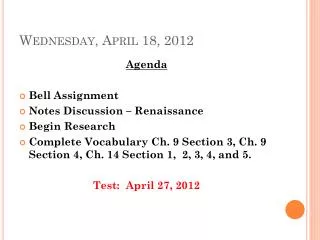
Wednesday, April 18, 2012 Agenda • Bell Assignment • Notes Discussion – Renaissance • Begin Research • Complete Vocabulary Ch. 9 Section 3, Ch. 9 Section 4, Ch. 14 Section 1, 2, 3, 4, and 5. Test: April 27, 2012
Bell Assignment Complete Vocabulary Ch. 9 Section 3, Ch. 9 Section 4, and Ch. 14 Section 1, 2, 3, 4, and 5.
The Renaissance Mr. Finch World History Ch. 14 Section 1
The Middle Ages • The Middle Ages can be described as the following: • Christianity is at the center of every aspect of life. • Most people are focused on heaven • Feudalism dominates society. • Warfare • 98% of population are peasants or serfs • No culture • Very little art/literature
Major Events of the Middle Ages • Charlemagne becomes Emperor – 800 A.D. • He tries to revive learning and culture, but is unsuccessful. • Crusades – 1096 A.D. – 1350 A.D. • People are driven by their faith (or greed) to reclaim Jerusalem from Muslim “invaders”. • Opens new trade routes/revives Europe’s economy. • Inspires western Europeans to revive learning and culture. • Black Death/Bubonic Plague – 1348 A.D. • Kills 1/3 of Europe’s population
The Renaissance • The Renaissance began in Florence Italy in 1425. • Why Italy? • It was the center of the Roman Empire. The Renaissance was marked by a renewed interest of Roman (Greek) culture. • Many Italian cities (Florence, Milan, Venice) survived the Middle Ages. • Wealthy and powerful merchants promoted cultural rebirth. • Cosimo Medici and Lorenzo de Medici
Ideals of the Renaissance • The Renaissance was a cultural rebirth of political, social, economic, and cultural aspect of European society. • The Renaissance was founded by new standards: • New World View • Renaissance thinkers focused on here and now rather than life after death (Heaven). • Spirit of adventure • A renewed spirit to explore new places and ideas • Humanism • Renaissance thinkers focused on worldly issues rather than religious issues.
A Golden Age in the Arts • The Renaissance is most known for the achievements in art, sculpture, and architect. • Renaissance art continued to reflect religious figures, such as , Jesus and Mary. However, they began to reflect prominent figures of the time (Lorenzo de Medici) to celebrate human achievement. • New techniques to represent people and landscapes in a realistic way. Artist began to use the rules of perspective. • Women artist became professional artist. (SofonisbaAnguissola) • Architecture • Revived Greek and Roman style architecture.
Medieval Art vs Renaissance Art 1. What are some differences between the art work? At least 3 differences
Three Geniuses of the Renaissance • Florence Italy was home to many outstanding artists during the Renaissance. • Three of the most famous artists are: • Leonardo da Vinci • Michelangelo • Raphael
Leonardo da Vinci • Leonardo was a true Renaissance man. He represented the ideals of adventure, humanism, and achievement. • Leonardo excelled in all areas: art, music, math, science, architecture, engineering. • He most noted for two of his paintings: • The Mona Lisa • The Last Supper
Michelangelo • Another famous artist is Michelangelo. He was talented in many areas, too. Although, he most well known as an artist. • His most famous works include: • Pieta • The ceiling of the Sistine Chapel
Raphael • Raphael studied the work of Leonardo da Vinci and Michelangelo. His paintings blend Christian and classical styles together. • He most well known for his paintings of Jesus and Mary. In addition, he painted the School of Athens. It included Socrates, Plato, Aristotle, and Averroes, a Muslim philosopher.
Writers of the Renaissance • During the Renaissance, many authors began to use Greek and Roman writings as examples to revive literature in Europe. • There were many “how-to” books that were written. • Baldassare Castiglione – The Book of the Courtier • How to be a model member of a royal court • Machiavelli – The Prince • How gain and maintain power as a ruler
Assignment • Go two www.dictionary.com and look up the following words: • Populace • Subservient • licentious • Trepidation • Then, turn to page 558 in your textbook.
Assignment • Read pg. 558. Then answer questions 1 – 3.
Website to Use for Research • http://www.avl.lib.al.us/