Understanding Co-Channel Interference in Cellular Systems: Key Concepts and Models
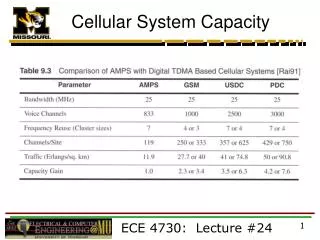
This introduction explores the essential concepts of cellular system propagation models, focusing on co-channel interference and cluster size (N). The cluster size is calculated based on the formula N = i² + ij + j², where i and j represent distances moved along hexagonal chains. By evaluating the co-channel reuse ratio (Q) and interference ratio (S/I), one can identify methods to reduce co-channel interference, such as sectorization. Tables provide critical data for understanding various values of N and their impact on cellular performance.

Understanding Co-Channel Interference in Cellular Systems: Key Concepts and Models
E N D
Presentation Transcript
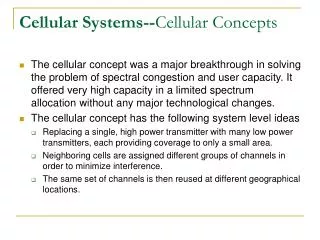
Cellular System Cellular concept Propagation models
The factor N is called the cluster size and is givenN=i2+ij+j2
To find the nearest co-channel neighbor of a particular cell, one must do the following: • move i cells along any chain of hexagons and then • turn 60 degrees counter-clockwise and move j cells.
Interference R - the radius of the cell D - the distance between centers of the nearest co-channel cells Q - the co-channel reuse ratio
Decreasing the co channel interference - sectorisation Table 2. Co-channel reuse ratio, S/I for values of N=7 using sectorial structure