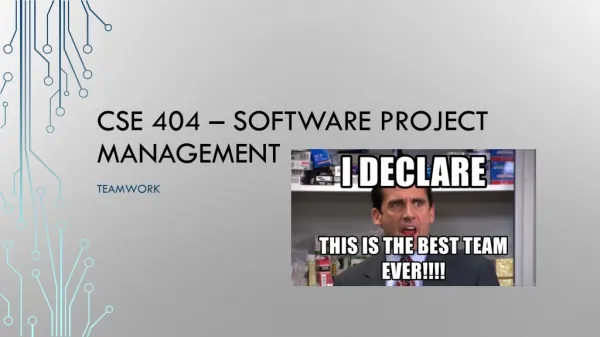
CSE 404 – Software Project Management
This content provides a comprehensive overview of effective teamwork in software project management. It outlines the stages of team development—Forming, Storming, Norming, and Performing—and the essential roles that team members play. The description highlights key strategies for enhancing collaboration, addressing conflict, and ensuring clear communication and responsibility. It emphasizes the importance of shared leadership, trust, and collective evaluation in producing successful problem-solving outcomes. The content serves as a guide to fostering a cohesive and productive team environment.

CSE 404 – Software Project Management
E N D
Presentation Transcript
Groups • Evaluated on how well it solves problem • Only purpose is developing solution • No individualized rewards • Meetings limited & often inefficient • Discusses tasks to little outcome • Poor coordination of efforts
Teams • Shares leadership & responsibility • Directed to solve well-defined problem • Evaluated individually & collectively • Utilizes open-ended discussions to draw out ideas • Active solving problems in meetings • Discusses, decides, & does real work together
Stages in Team Building Forming Storming Norming Performing
Stage 1: FORMING • Defines problem & agrees on goals • Formulates strategies for tackling the tasks • Determines challenges to be overcome • Identifies information needed • Members take on roles • Develops trust and lines of communication
Team Roles - Leader • Leads by example • Encourages open communication • Focuses team on task • Facilitates problem solving & collaboration • Motivates and inspires team • Recognizes & celebrates contributions
Other USEFUL Team Roles • Recorder - Records ideas; should track quotes and not add edits or evaluation • Skeptic - Presents potential flaws in ways thatencourages developing solutions • Timekeeper – Keeps meetings running on time • Gate Keeper - Ensures each member provides input
Other USEFUL Team Roles • Recorder - Records ideas; should track quotes and not add edits or evaluation • Skeptic - Presents potential flaws in ways thatencourages developing solutions • Timekeeper – Keeps meetings running on time • Gate Keeper - Ensures each member provides input • Gimli – Brings his axe
Stage 2: STORMING • Realize task harder than expected • Fluctuate in expectations of success • May start to resist tasks • Collaboration issues often occur
Questions to Answer in Storming Phase • Do we have common goals and objectives? • Do we agree on roles and responsibilities? • Do our task, communication, and decision systems work? • Do we have adequate interpersonal skills?
Questions to Answer in Storming Phase • Do we have common goals and objectives? • Do we agree on roles and responsibilities? • Do our task, communication, and decision systems work? • Do we have adequate interpersonal skills?
Constructive Conflict • Opens up about important problems … • …but focuses on finding solutions to problems • Increases all individuals involvement • Reinforces authentic communication • Releases emotion, anxiety & stress • Builds cohesiveness by celebrating settlement
Destructive Conflicts • Diverts energy & prevents progress • Destroys morale and faith in team • Reinforces poor habits and behaviors • Polarizes team & deepens divisions • Leads to name-calling, gossiping, & worse
Ways of Addressing issues • Focus on meeting needs & goals so that solution long-lasting • Clarify core issues • State opinions in clear non-judgmental language. • Listen carefully to each person • Verify understanding by restating core issues • Repeat as needed
How to Be Leader During Times of Conflict • Separate problem issues from people issues • Review why each person is so invested • Look for underlying needs creating issues • Be forgiving to people to reinforce trust • Ensure focus always on problems • Be tenacious to show resolution matters
Stage 3: NORMING • Members of the team now accept: • Workings of the team • Rules and procedures being used • Their specific role on the team • Roles of all the other team members • Team starts trusting each other • Common belief that success is likely
Norming Team Behaviors • Team members move from competition to cooperation • Willingness to confront & solve issues • Constructive criticism possible & helpful • Team spirit develops
Stage 4: PERFORMING • Understand personal and team processes • Accept each other’s strengths and weaknesses • Roles chosen which utilizes everyone fully • Space provided for growth & improvement • Avoid most conflicts & resolves differences when conflict do arise • Strong attachment to team & teammates
Recipe for Successful Team • Clear communication • Well-defined decision procedures • Clear ground rules followed by all • Balanced participation • Good personal relationships
Teamwork Activity • Create 3 columns titled: Nightmare, Good, & Excellent • Describe 1 Nightmare & Excellent teamwork situations you have experienced • Describe 2 Good teamwork situations you have experienced
Teamwork Activity • Create 3 columns titled: Nightmare, Good, & Excellent • Describe 1 Nightmare & Excellent teamwork situations you have experienced • Describe 2 Good teamwork situations you have experienced • What are the qualities that differentiated Good & Excellent situations?
Teamwork Activity • Create 3 columns titled: Nightmare, Good, & Excellent • Describe 1 Nightmare & Excellent teamwork situations you have experienced • Describe 2 Good teamwork situations you have experienced • What are the qualities that differentiated Good & Excellent situations? • Finally, label whether each of your situations was due to:People or Environment