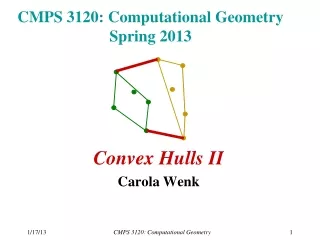
CMPS 3120: Computational Geometry Spring 2013
50 likes | 181 Vues
This text covers geometric shape matching, focusing on the fundamentals of computing distances between two shapes composed of various point sets, line segments, and triangles. It introduces the Hausdorff distance, including both directed and undirected distances, and outlines the computational complexities involved. The application areas include character recognition, fingerprint identification, molecule docking, image interpretation, robotics, and more. This study aims to explore transformations between shapes and the implementations for efficient matching algorithms in computational geometry.


CMPS 3120: Computational Geometry Spring 2013
E N D
Presentation Transcript
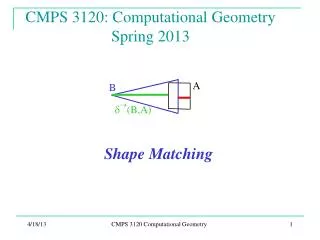
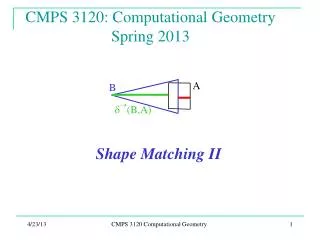
CMPS 3120: Computational GeometrySpring 2013 A B d(B,A) Shape Matching II CMPS 3120 Computational Geometry
Geometric Shape Matching Given: Twogeometric shapes, each composed of a number of basic objects such as points line segments triangles An application dependantdistance measured, e.g., the Hausdorff distance A set of transformations T, e.g., translations, rigid motions, or none min d(T(A),B) Matching Task: Compute TÎT CMPS 3120 Computational Geometry
Hausdorff distance • Directed Hausdorff distance d(A,B) = max min || a-b || • Undirected Hausdorff-distance d(A,B) = max (d(A,B) , d(B,A) ) A B a A bB d(B,A) d(A,B) • If A, B are discrete point sets, |A|=m, |A|=n • In d dimensions: Compute in O(mn) time brute-force • In 2 dimensions: Compute in O((m+n) log (m+n) time • Compute d(A,B) by computing VD(B) and performing nearest neighbor search for every point in A CMPS 3120 Computational Geometry
Shape Matching - Applications • Character Recognition • Fingerprint Identification • Molecule Docking, Drug Design • Image Interpretation and Segmentation • Quality Control of Workpieces • Robotics • Pose Determination of Satellites • Puzzling • . . . CMPS 3120 Computational Geometry
Hausdorff distance • W(m2n2) lower bound construction for directed Hausdorff distance of line segments under translations CMPS 3120 Computational Geometry