HES HKS Meeting 2010: Analysis of e/e+ Rejection and Moller Scattering in JLab Hall C
110 likes | 231 Vues
This document provides insights from the HES HKS meeting held on November 15, 2010, focusing on the experimental setup in JLab Hall C. It discusses electron and positron rejection techniques in the h_tof_pre.f framework, the rate of Moller scattering, and the analysis of real data with a specific emphasis on background rejection. Various simulations highlight the performance metrics including file size, analysis time, and electron rates at different beam currents. Key findings include the efficiency of the POSI method and the implications for future analysis and experimentation.


HES HKS Meeting 2010: Analysis of e/e+ Rejection and Moller Scattering in JLab Hall C
E N D
Presentation Transcript
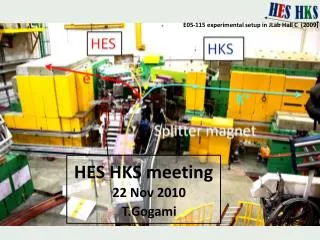
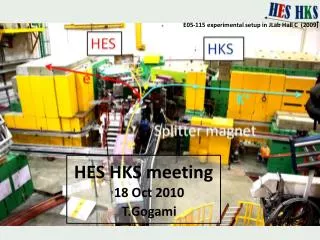
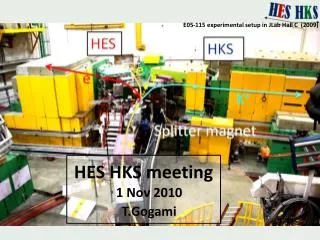
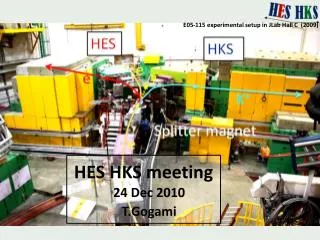
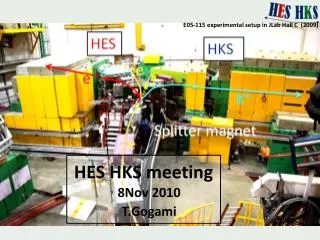
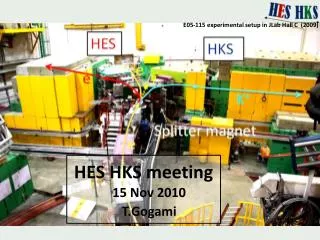
E05-115 experimental setup in JLab Hall C (2009) HES HKS meeting 15 Nov 2010 T.Gogami
Content • e , e+ rejection in h_tof_pre.f • POSI • Electron rate • Moller
REAL DATA e , e’ background Reject e,e+ in h_tof_pre.f • NO CHANGE FOR • OPTICS • K+ h_tof_pre.f
File size and analysis time File size 46% ~ 78 % Time 90%
Number Reconstruction with POSI ~ 4 [MHz] HES single
Theta vs. Phi cut Chromium target SIMULATION • HES • EDCTrig • EYQ1i > -4.7 [cm] • POSI • Electron flag
SIMULATION Electron Rates Events :92/(2G) 700 – 988 [MeV/c] 2.3 ± 0.24 [MHz] at 7.9 [μA] ~ OK Electrons which are not on optics. Simulation is loose
SIMULATION Added new leaves ( POSI ) • Electron • Beam Passing through • Ionization • Brems. • Photon • Compton scattering • Photoelectric effect • Photon conversion
CALCULATION Cross section of Moller scattering
Summary and to do • Summary • e , e+ rejection in h_tof_pre.f • POSI • Electron rate • Moller • to do • Analysis • Residual of chambers for each arm. • HES tracking • Strangeness 2010 in KEK • Preparation • タイヤ交換