Comprehensive Overview of Chordata: Vertebrates, Adaptations, and Evolutionary Trends
460 likes | 597 Vues
This comprehensive review covers the Chordata phylum, focusing on vertebrates—fish, amphibians, reptiles, birds, and mammals. It explores their defining characteristics, anatomy, and physiological functions, including the transition from aquatic to terrestrial life, adaptations for survival, and reproductive strategies. Key evolutionary concepts such as adaptive radiation and convergent evolution highlight the diversity of life forms. Additionally, this review touches upon homeostasis through temperature regulation and adaptations in feeding and respiration among vertebrates.


Comprehensive Overview of Chordata: Vertebrates, Adaptations, and Evolutionary Trends
E N D
Presentation Transcript
Animals: The Chordata Phylum Review Chapters 30-32:
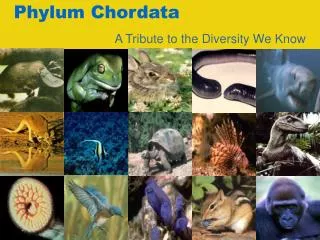
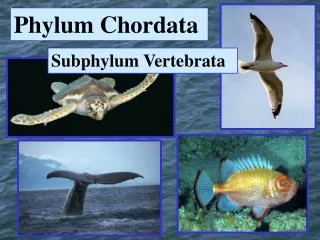
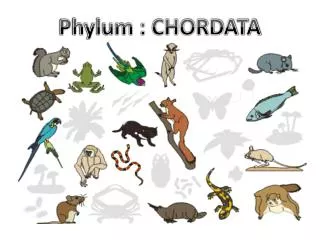
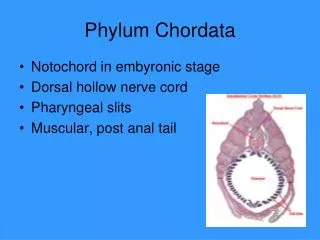
Chordata • Vertebrates • fish, amphibians, reptiles, birds, mammals • internal bony skeleton • backbone encasing spinal column • skull-encased brain • deuterostome hollow dorsal nerve cord becomes brain & spinal cord becomes gills or Eustachian tube pharyngeal pouches becomes vertebrae postanal tail becomes tail or tailbone notochord
450 mya salmon, trout, sharks Vertebrates: Fish • Characteristics • body structure • bony & cartilaginous skeleton • jaws & paired appendages (fins) • scales • body function • gills for gas exchange • two-chambered heart; single loop blood circulation • ectotherms • reproduction • external fertilization • external development in aquatic egg gills body
Humerus Femur Ulna Pelvis Shoulder Tibia Radius Lobe-finned fish Fibula Femur Pelvis Humerus Shoulder Radius Tibia Ulna Fibula Early amphibian Transition to Land Evolution of tetrapods
lung buccal cavity glottis closed 350 mya frogs salamanders toads Vertebrates: Amphibian • Characteristics • body structure • legs (tetrapods) • moist skin • body function • lungs (positive pressure) & diffusion through skin for gas exchange • three-chambered heart;veins from lungs back to heart • ectotherms • reproduction • external fertilization • external development in aquatic egg • metamorphosis (tadpole to adult)
leathery shell embryo amnion chorion allantois yolk sac 250 mya dinosaurs, turtles lizards, snakes alligators, crocodile Vertebrates: Reptiles • Characteristics • body structure • dry skin, scales, armor • body function • lungs for gas exchange • thoracic breathing; negative pressure • three-chambered heart • ectotherms • reproduction • internal fertilization • external development in amniotic egg
lung trachea anterior air sacs posterior air sacs 150 mya finches, hawk ostrich, turkey Vertebrates: Birds (Aves) • Characteristics • body structure • feathers & wings • thin, hollow bone;flight skeleton • body function • very efficient lungs & air sacs • four-chambered heart • endotherms • reproduction • internal fertilization • external development in amniotic egg
muscles contract diaphragm contracts 220 mya / 65 mya mice, ferret elephants, batswhales, humans Vertebrates: Mammals • Characteristics • body structure • hair • specialized teeth • body function • lungs, diaphragm; negative pressure • four-chambered heart • endotherms • reproduction • internal fertilization • internal development in uterus • nourishment through placenta • birth live young • mammary glands make milk
Vertebrates: Mammals • Sub-groups • monotremes • egg-laying mammals • lack placenta & true nipples • duckbilled platypus, echidna • marsupials • pouched mammals • offspring feed from nipples in pouch • short-lived placenta • koala, kangaroo, opossum • placental • true placenta • nutrient & waste filter • shrews, bats, whales, humans
Vertebrate quick check… • Which vertebrates lay eggs with shells? • Which vertebrates are covered with scales? • What adaptations do birds have for flying? • What kind of symmetry do all vertebrates have? • Which vertebrates are ectothermic and which are endothermic • Why must amphibians live near water? • What reproductive adaptations made mammals very successful? • What characteristics distinguish the 3 sub-groups of mammals?
Comparing Chordates Chapter 33:
Evolutionary Trends in Vertebrates • Adaptive Radiation: process by which a single species or small group of species evolves into several different forms that live in different ways • Rapid growth in the diversity of a group of organisms • Convergent Evolution: process by which unrelated organisms independently evolve similarities when adapting to similar environments
Body Temperature & Homeostasis • The control of body temperature is important for maintaining homeostasis in vertebrates… • Particularly in habitats where temperature varies widely within time of day and with season
Body Temperature & Homeostasis • Ectotherm: animal that relies on interactions with the environment to help it control body temperature (“cold blooded”) • Reptiles, fishes and amphibians
Body Temperature & Homeostasis • Endotherm: animal that generates its own body heat and controls its body temperature from within (“warm blooded”) • Birds and mammals
Feeding • Skulls and teeth adapted for feeding on a much wider assortment of foods
Respiration • Aquatic chordates: tunicates, fishes, and amphibian larvae • GILLS • Land vertebrates: adult amphibians, reptiles, birds, and mammals • LUNGS
Circulation • Single-loop Circulation • Double-loop Circulation • Heart Chambers (3 or 4)
Excretion • Carried out by the kidneys
Response • Nonvertebrate chordates have a relatively simple nervous system with a mass of nerve cells that form a brain • Vertebrates have a more complex brain with distinct regions, each with a different function
Movement • The skeletal and muscular system support a vertebrate’s body and make it possible to control movement
Reproduction • Almost all chordates reproduce sexually • Oviparous: eggs develop outside the mother’s body • Ovoviviparous: eggs develop within the mother’s body –young born alive • Viviparous: embryos obtain nutrients directly from the mother’s body-young born alive
Animal Behavior Chapter 34:
Elements of Behavior • Behavior: the way an organism reacts to changes in its internal condition or external environment • Stimulus: any kind of detectable sign that carries information • Response: single, specific reaction to a stimulus
Types of Stimuli • Light • Sound • Odors • Heat • THE SENSES • Some are different for different animals; i.e. echolocation in dolphins
How Animals Respond • When an animal responds to a stimulus, the body systems… • sense organs • nervous system • muscles • …interact to produce the resulting behavior
Behavior and Evolution • Innate Behavior: instinct, or inborn behavior; behavior that appears in a fully functional form the first time it is performed • Learned Behavior: behavior that is altered as a result of experience
Learned Behavior • Habituation • Classical conditioning • Operant conditioning • Insight learning
Habituation • Learning process by which an animal decreases or stops its response to a repetitive stimulus that neither rewards nor harms it
Learning process in which an animal makes a mental connection between a stimulus and some kind of reward or punishment Classical Conditioning
Operant Conditioning • Learning process in which an animal learns to behave in a certain way through repeated practice, in order to receive a reward or avoid punishment • Trial-and-error learning
Insight Learning • Learning process in which an animal applies something it has already learned to a new situation without a period of trial and error • Reasoning
Imprinting • Learning based on early experience • Once imprinting has occurred, the behavior cannot be changed
Patterns of Behavior • Behavioral Cycles • Courtship • Social Behavior • Competition and Aggression • Communication
Behavioral Cycles • Many animals respond to periodic changes in the environment with daily or seasonal cycles of behavior • Migration: periodic movement and return of animals from one place to another • Circadian Rhythm: behavioral cycle that occurs in a daily pattern; i.e. sleep
Courtship • Type of behavior in which an animal sends out stimuli… • Sounds • Visual displays, or • Chemicals • …in order to attract a member of the opposite sex
Social Behavior • Usually members of a society are related to one another • Related individuals share a large proportion of each other’s genes • Helping a relative survive increases the chance that the genes an individual shares with that relative will be passed along to offspring
Competition and Aggression • Territory: specific area occupied and protected by an animal or group of animals • Aggression: threatening behavior that one animal uses to gain control over another
Communication • Passing of information from one organism to another • Visual signals • Chemical signals • Sound signals • Language**
Animal Behavior Terminology • Behavior • Anything an animal does in response to a stimulus in its environment • Innate behavior • Inherited behavior of animals (instinctive) • Ex. The way a toad catches its prey. • Fight-or-flight response • Preparation of the body to either fight or run from the danger • Controlled by hormones
Animal Behavior Terminology • Instinct • A complex pattern of innate behavior that begins with a stimulus and continues until all responses have been completed • Ex. Migration, aggressive behavior, courtship behavior, circadian rhythm, and territorial behavior • Circadian rhythm • A 24-hour cycle of behavior, cycle of sleeping and wakefulness • Mimicry • The resemblance of one organism to another or to an object in its surroundings for concealment and protection from predators
Animal Behavior Terminology • Migration • The instinctive seasonal movement of animals • Ex. Birds, Pacific salmon • Hibernation • A state in which the body temperature drops substantially, oxygen consumption decreases, and breathing rates decline to a few breaths per minute in order to conserve energy • Ex. Bears • Habituation • A repeated stimulus that the animal finally ceases to respond to
Animal Behavior Terminology • Imprinting • When an animal at a critical time of its life forms a social attachment to another object • Ex. Ducklings attachment to its mother • Conditioning • Learning by association • Insight • Learning when an animal uses previous experiences to respond to a new situation