Strategies for Maintaining and Developing Competencies in Anaesthesia Practice
240 likes | 356 Vues
This document discusses essential strategies for maintaining and developing competencies as an anaesthetist. It emphasizes the importance of lifelong learning and staying updated through appropriate Continuing Professional Development (CPD) activities. Key points include guidance on selecting relevant CPD opportunities, ensuring quality assurance of these activities, and overcoming challenges in maintaining competence. Additionally, it highlights the need for clinical and non-clinical knowledge, collaboration among professional bodies, and the importance of evaluating learning outcomes through feedback mechanisms.


Strategies for Maintaining and Developing Competencies in Anaesthesia Practice
E N D
Presentation Transcript
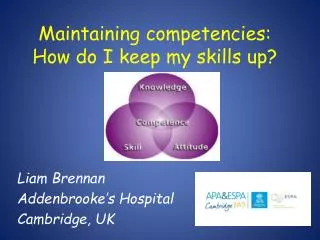
Maintaining competencies: How do I keep my skills up? Liam Brennan Addenbrooke’s Hospital Cambridge, UK
Conflict of interest • I am an elected Council member of The Royal College of Anaesthetists • I am the former RCoA national CPD adviser • Editor, CEACCP • No financial conflicts of interest
Key learning points • Maintaining & developing competencies • How to select appropriate CPD activity • Quality assurance of CPD activity • Obstacles to maintaining competence
Why maintain & develop competencies? • Professional obligations • Pressure from medical regulators • High profile catastrophes • Increased expectations from patients • Life-long learning • Cross-border working
How many cases? Kestin et al, 1995
Experiential learning • ~ 2500-3000 cases overall in 7 year training • ‘Competence’ = ~ 30 cases in all sub-specialities (Intermediate/higher training) • ‘Expert’ = 100+ cases in one sub-speciality (Advanced training) • Mastery not achieved pre-CCT CCT is only the start of life-long learning
Which competencies do I need to maintain or develop? • Differences between CME and CPD • Need to consider: • maintaining basic standards ; clinical & non-clinical • keeping up to date in your chosen field of expertise • acquiring and developing new skills • Guidance from regulator/professional organisations • Results of MSF, audit & complaints • Should reflect your whole practice* Whole Practice = clinical & non-clinical ; scheduled & out of hours; independent practice & voluntary work
Rome group CPD recommendations (2004) Accrediting body • Fair, valid & consistent • Set reasonable & credible standards • Quality assurance role • Encourage collaboration between accrediting bodies • Learner • CPD meets their educational needs • Ensure CPD is relevant to their whole practice • Evaluates the extent to which their needs have been met • Organiser/provider • Disclosure of commercial sponsorship • Commercial sponsors must not influence structure • or content of educational activity
Level 1 • Core knowledge & skills recommended of all those who trained as anaesthetists • Combines clinical & non-clinical components • Includes maintaining a broad knowledge of scientific principles • Achievable via review of clinical activity, local meetings, e-learning
Level 2 • Paediatric competencies relevant to non-specialist anaesthetist who manages children ≥ 3 years old • Excludes infant and neonatal practice (other than emergency stabilisation) • Includes team working with retrieval teams and liaison with specialist referral centre
Level 3 http://www.apagbi.org.uk/professionals/education-and-training/revalidation/cpd-matrix/level-3-matrix
Level 3 • Aimed at specialist paediatric anaesthetists • UK advice developed by APA • Should reflect ‘state of the art’ practice • Likely to require attendance at national and international meetings
Resources to maintain competence • Multi-faceted learning methods are optimal • Recognise that people learn in different ways • Group learning (in clinical teams) is very effective • Methods: • Traditional didactic lectures • Personal study • Experiential courses • Simulation e.g. MEPA • Sabbaticals • Working with colleagues • e-learning • Personal reflection on learning essential
How do we know our competence has improved? • Re-audit of practice • Repeat multi-source feedback (inc patient) • Before and after tests of knowledge • Simulator performance in test situations • Peer-review of practice Peer Review
Quality assurance • Ensures CPD activities meet educational, organisational & probity standards • In UK, QA role coordinated by a CPD Board: • Speciality wide representation; RCoA & specialist societies • Appoints CPD assessors • Decides CPD credit allocation • Periodically reviews content of CPD matrix • Reviews participant feedback from CPD activities
Harmonisation of CPD Many obstacles still to overcome: - Mandatory or voluntary - Statutory or professional regulation - Consequences of non-compliance EACMME has made progress Definite benefits for all stakeholders CPD For debate: Should APA & ESPA develop a European specialist paediatric anaesthesia CPD matrix?
Key learning points • Maintaining & developing competencies • How to select appropriate CPD activity • Quality assurance of CPD activity • Obstacles to maintaining competence