Download
1 / 67
670 likes | 829 Vues
This lecture delves into the foundational concepts of electric currents and electromagnetism, examining the motion of electric charges in both the micro and macro worlds. It covers key topics such as the behavior of positive ions, the function of batteries, the principles of electric current flow, and key equations governing electricity, like Ohm's Law and Faraday's Law. The concepts of magnetic fields produced by electric currents, the interaction of charges, and practical applications in technology, including motors and generators, are also discussed, providing a comprehensive understanding of electromagnetism's principles.

E N D
Electric currents& Electromagnetism Micro-world Macro-world Lecture 9
Electric currents (Motion of electric charges) Micro-world Macro-world Lecture 9
Positive Ions Atoms with one or more electrons removed _ _ + + + _ _ _ + + _ _ _ ”net” charge = +2qe
Battery C Zn Zn - - + + Zn Zn++ Zn++ Zn - - - - Zn Zn + + - - Zn++ - - Zn Zn Zn++ + + acid
“Voltage” Cathode Anode - + - - + + - - + + - E - + + - Zn++ - F + + W = Fd “Voltage” F = 2qeE d W0 2qe V W = 2qeEd W0 = 2qeE0d =E0d
Energy gained by the charge W = Fd =Q E0d = QV F=QE0 F=QE0 Q Q Anode - + Cathode - E0 - + + - - + + Zn++ - - + + - Zn++ - + + d
Units again! W = Q V joules joules coulomb W Q V = = Volt coulombs joule coulomb 1 V = 1
Continuous charge flow = “electric current” Electrical “conductor” connected between anode & cathode Q Q Anode - + Cathode - - + + - - + + Zn++ - - + + - Zn++ - + +
electric current Coulombs second Units: Q t I = =Amperes Q Q Anode - + Cathode - - + + - - + + Zn++ - - + + - Zn++ - + +
The conductor can be a piece of wire Q t I = + + + Anode - + Cathode - - + + - - + + Zn++ - - + + - Zn++ - + +
The energy can be used to run a gadget Energy time QV t P= = = I V + I + + I I Anode - + Cathode - - + + - - + + Zn++ - - + + - Zn++ - + +
Electric light 60 Watts I=? T Power = P = I V P V 60 W 100V I = = J/s J/C 1/s 1/C = 0.6 = 0.6 C s V=100V = 0.6 = 0.6 A
General circuit I Appliance - + I + - 12V Energy source (device that separates + & - charge)
analogy Amt of water flow ~ current appliance Height ~ voltage Pump ~ battery pump pond
Current loop S N
Even more loops S N
Solenoid coil S N Looks like a bar magnet
Atomic magnetism B + I - Some atoms are little magnets
Forces on two parallel wires I I Current in same direction: wires attract B
Forces on two parallel wires I Current in opposite directions: wires repel B I
Force law of Biot & Savart I1 I2 I1I2l d F = k l N A2 k=2x10⁻⁷ B d
Biot & Savart example I1I2l d 20A 20A F = k (20A)2 2m 0.01m N A2 F= 2x10⁻⁷ 2m B F= 2 x 10⁻³N Small, but not tiny 0.01m
Electric motor F I I B F
Electric motor B I
Speakers Solenoid Electro-magnet Permanent magnet
Lorentz force B v F +q i=qv if v B: F = iB = qvB direction by the right-hand rule
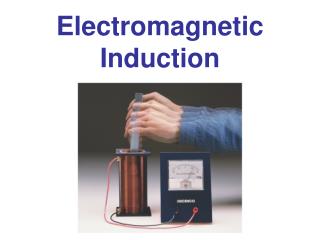
Electromagnetism Michael Faraday Faraday’s Law
Use this to drive an electric circuit + + + + I +
Moving wire loop in a B field v + + An electric current is “induced” in the loop
Either the magnet or the loop can move v + + an electric current is “induced” in the loop
Magnetic flux (F) thru a loop F = BA┴
Flux thru a coil of N loops F = NBA┴
Faraday’s law Michael Faraday change in F elapsed time Induced voltage in a circuit = change in NBA┴ elapsed time EMF = “Electro-Motive Force”
Rotating coil in B field B A┴ = 0 F =0
Rotating coil in B field B A┴ = Acoil F = maximum
Rotating coil in B field B A┴ = 0 (again) F = 0
Lenz’ Law B B S B-field from induced current + + B-field from induced current I N v v the fall produces an induced current the B-field produced by the induced current tries to impede the fall
Lenz’ law An induced voltage always gives rise to an electric current that creates a magnetic field that opposes the influence that produced it.