Understanding Number Systems: Decimal, Binary, Octal, and Hexadecimal Conversions
Explore the realm of number systems with a comprehensive guide on decimal, binary, octal, and hexadecimal conversions. This tutorial covers how to convert between these bases, techniques for binary to decimal and vice versa, including the multiplication and addition of binary numbers. Learn the use of common powers in computing and how to manage fractions in binary notation. Gain a thorough understanding of these concepts to enhance your computational skills in various applications.

Understanding Number Systems: Decimal, Binary, Octal, and Hexadecimal Conversions
E N D
Presentation Transcript
Conversion Among Bases • The possibilities: Decimal Octal Binary Hexadecimal
Decimal to Decimal (just for fun) Decimal Octal Binary Hexadecimal
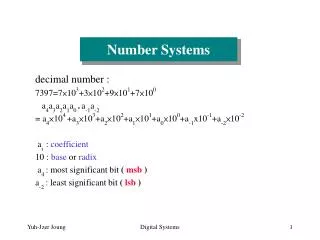
Weight 12510 => 5 x 100 = 5 2 x 101 = 20 1 x 102 = 100 125 Base
Binary to Decimal Decimal Octal Binary Hexadecimal
Binary to Decimal • Technique • Multiply each bit by 2n, where n is the “weight” of the bit • The weight is the position of the bit, starting from 0 on the right • Add the results
Example Bit “0” 1010112 => 1 x 20 = 1 1 x 21 = 2 0 x 22 = 0 1 x 23 = 8 0 x 24 = 0 1 x 25 = 32 4310
Decimal to Binary Decimal Octal Binary Hexadecimal
Decimal to Binary • Technique • Divide by two, keep track of the remainder • First remainder is bit 0 (LSB, least-significant bit) • Second remainder is bit 1 • Etc.
2 125 62 1 2 31 0 2 15 1 2 3 1 2 7 1 2 0 1 2 1 1 Example 12510 = ?2 12510 = 11111012
Common Powers (1 of 2) • Base 10
Common Powers (2 of 2) • Base 2 • What is the value of “k”, “M”, and “G”? • In computing, particularly w.r.t. memory, the base-2 interpretation generally applies
/ 230 = Example In the lab…1. Double click on My Computer2. Right click on C:3. Click on Properties
Review – multiplying powers • For common bases, add powers ab ac = ab+c 26 210 = 216 = 65,536 or… 26 210 = 64 210 = 64k
Binary Addition (1 of 2) • Two 1-bit values “two” pp. 36-38
Binary Addition (2 of 2) • Two n-bit values • Add individual bits • Propagate carries • E.g., 1 1 10101 21+ 11001 + 25 101110 46
Multiplication (2 of 3) • Binary, two 1-bit values
Multiplication (3 of 3) • Binary, two n-bit values • As with decimal values • E.g., 1110 x 1011 1110 1110 0000 111010011010
Fractions • Binary to decimal 10.1011 => 1 x 2-4 = 0.0625 1 x 2-3 = 0.125 0 x 2-2 = 0.0 1 x 2-1 = 0.5 0 x 20 = 0.0 1 x 21 = 2.0 2.6875
Fractions • Decimal to binary .14579x 20.29158x 20.58316x 21.16632x 20.33264x 20.66528x 21.33056 etc. 3.14579 11.001001...