Download
1 / 12
120 likes | 238 Vues
This article explores the different types of muscles in the human body, including voluntary and involuntary muscles. Involuntary muscles, such as those in the heart and diaphragm, function without conscious control, while voluntary muscles, like those used for movement and facial expressions, are under our conscious command. It also highlights the importance of skeletal, smooth, and cardiac muscles, their contraction mechanisms, and how exercise contributes to muscle growth, making tendons essential connections between muscles and bones.

E N D
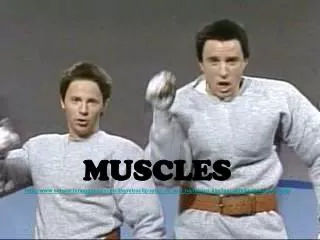
MUSCLEShttp://www.schwarzenegger.com/en/life/retroclip/retro_en_arn_hanzfranz.asp?sec=life&subsec=retroclipMUSCLEShttp://www.schwarzenegger.com/en/life/retroclip/retro_en_arn_hanzfranz.asp?sec=life&subsec=retroclip
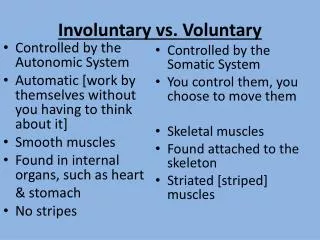
Involuntary Muscles Involuntary Muscles Muscles that are not under your conscious control. Examples - heart, muscles used for breathing
Voluntary Muscles • Muscles that are under your conscious control. • Examples – smiling, turning a page in a book, and standing up.
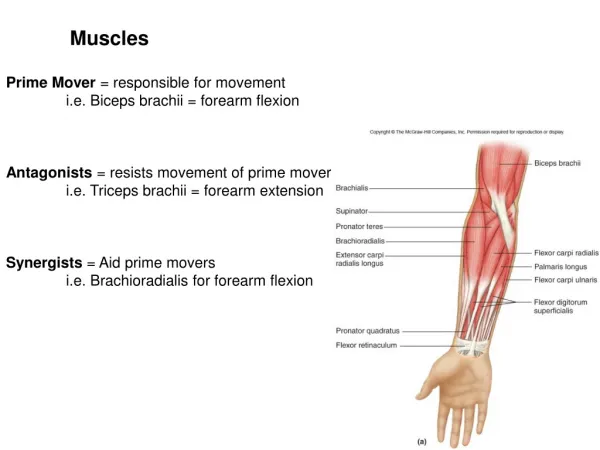
Skeletal • Are attached to the bones of your skeleton and provide the force that moves your bones. • They are Striated • Striated - banded
Smooth • Involuntary muscles such as those in your stomach that aid in digestion.
Cardiac • Found in your heart. • It is involuntary, and striated.
Contraction • Muscle cells can only contract, not extend , so skeletal muscles must work in pairs. • While one contracts the other muscle relaxes to its original length.
Exercise • Exercise makes muscle cells grow in size. As a result, the whole muscle becomes thicker, and therefore stronger.
Tendons • Tendons are strong connective tissue that connect muscle to bone.