Chapter 10 The Structure and Function of DNA
520 likes | 673 Vues
Chapter 10 The Structure and Function of DNA. CM Lamberty General Biology. Biology and Society . Flu Virus The influenza virus is one of the deadliest pathogens in the world. Each year in the United States, over 20,000 people die from influenza infection.


Chapter 10 The Structure and Function of DNA
E N D
Presentation Transcript
Chapter 10The Structure and Function of DNA CM Lamberty General Biology
Biology and Society • Flu Virus • The influenza virus is one of the deadliest pathogens in the world. • Each year in the United States, over 20,000 people die from influenza infection. • In the flu of 1918–1919, about 40 million people died worldwide. • Vaccines against the flu are the best way to protect public health. • Because flu viruses mutate quickly, new vaccines must be created every year.
DNA Structure and Replication • Molecular Biology • Was known to be a chemical in cells by the end of the nineteenth century • Has the capacity to store genetic information • Can be copied and passed from generation to generation
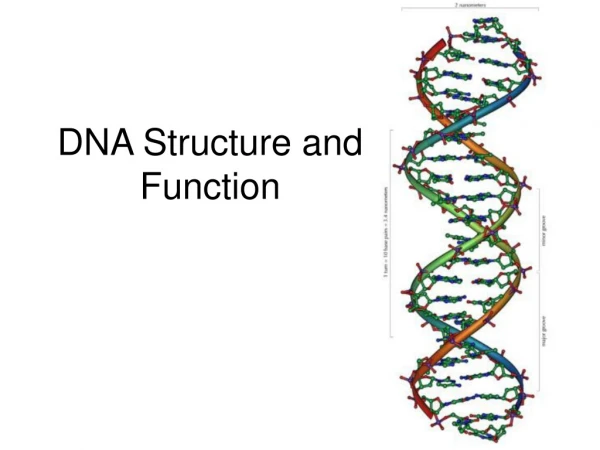
DNA and RNA Structure • Nucleotides • Polynucleotides • Sugar-phosphate backbone • DNA: • 4 nucleotides • Thymine, T • Cytosine, C • Adenine, A • Guanine, G Uracil instead of thymine in RNA
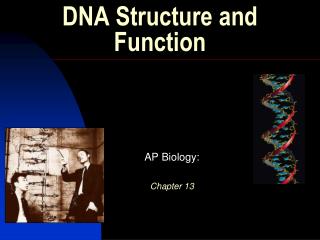
Watson and Crick (and Franklin) • Determination of DNA double helix structure • From photo of X-ray image taken by Rosalind Franklin: diameter of helix is uniform, thickness suggested 2 polynucleotide strands • Combined info from x-ray photos and known data • Backbones allowed for the swivel in the interior • Base-pairs for support • originally AA or CC but that would cause bulges • Became apparent for double ring with single ring • Hydrogen bonding to link pairs • dasd
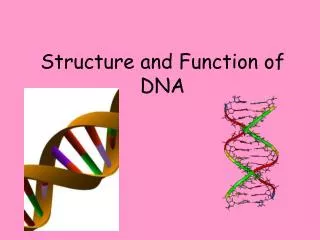
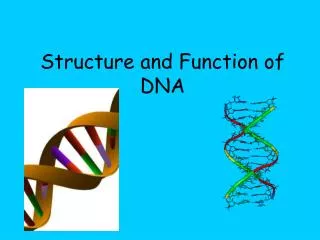
Rope Ladder Analogy • The model of DNA is like a rope ladder twisted into a spiral. • The ropes at the sides represent the sugar-phosphate backbones. • Each wooden rung represents a pair of bases connected by hydrogen bonds.
DNA Replication • DNA • Known to be a chemical in cells at end of 19th century • Has capacity to store genetic information • Can be copied and passed from generation to generation • DNA and RNA are nucleic acids • Consist of chemical unit called nucleotides • Nucleotides joined by sugar-phosphate backbone
DNA Replication • When a cell reproduces, a complete copy of the DNA must be passed on • Watson & Crick’s model suggested DNA replicates by a template mechanism
DNA Replication • DNA can be damaged by UV light • DNA polymerase: • Are enzymes • Make the covalent bond b/t nucleotides of a new DNA strand • Are invovled in repairing damaged DNA • DNA repliation in eukaryotes: • Begins at specific sties on a double helix • Proceeds in both directions
Flow of Genetic Information • DNA functions as the inherited directions for a cell or organism • How are the directions carried out?
How Genotype determines Phenotype • An organism’s genotype is its genetic makeup, the sequence of nucleotide bases in DNA • The phenotype is the organism’s physical traits, which arise from the actions of a wide variety of proteins • DNA specifies synthesis of proteins in 2 stages: • Transcription, the transfer of genetic information from DNA into an RNA molecule • Translation, the transfer of information from RNA into a protein
Nucleus DNA Cytoplasm Figure 10.8-1
Nucleus DNA TRANSCRIPTION RNA Cytoplasm Figure 10.8-2
Nucleus DNA TRANSCRIPTION RNA TRANSLATION Protein Cytoplasm Figure 10.8-3
How Genotype determines Phenotype • The function of a gene is to dictate the production of polypeptide • A protein may consist of two or more different polypeptides
From Nucleotides to Amino Acids • Genetic information in DNA is • Transcribed into RNA then • Translated into polypeptides • What is the language of nucleic acids? • In DNA, it is the linear sequence of nucleotide bases • A typical gene consists of 1000s of nucleotides • A single DNA molecule may contains 1000s of genes • When DNA is transcribed, the result is an RNA • RNA is then translated into sequence of amino acids into a polypeptide • What are the rules for translating RNA message? • A codon is a triplet of bases which codes for one amino acid
The Genetic Code • Genetic code is the set of rules relating to nucleotide sequence to amino acid sequence • Is shared by all organisms • Of the 64 triplets • 61 code for amino acids • 3 are stop codons, indicating the end of the polypeptide
Transcription: from DNA to RNA • Transcription • Makes RNA from a DNA template • Uses a process that resembles DNA replication • Substitutes uracil (U) for thymine (T) • RNA nucleotides are linked by RNA polymerase • Initiation • The “start transcribing” signal is a nucleotide sequence called a promoter • The 1st phase of transcription is initiation in which • RNA polymerase attaches to the promoter • RNA synthesis begins
Transcription: from DNA to RNA • RNA Elongation • 2nd phase • RNA grows longer • RNA strand peels away form the DNA template • Termination • 3rd phase • RNA polymerases reaches a sequence of DNA bases called terminator • Polymerases detaches from RNA • The DNA strands rejoin
The Processing of Eukaryotic RNA • After transcription • Eukaryotic cells process RNA • Prokaryotic cells do not • RNA processing include • Adding a cap and tail • Removing introns • Splicing exons together to form messenger RNA (mRNA)
Translation: The Players • Translation is the conversion from the nucleic acid language to the protein language • Translation requires • mRNA • ATP • Enzymes • Ribosomes • Transfer RNA (rRNA)
Transfer RNA (tRNA) • Acts as a molecular interpreter • Carries amino acids • Matches amino acids with codons in mRNA using anticodons
Ribosomes • Organelles that • Coordinate the functions of mRNA and tRNA • Are made of two protein strands • Contain ribosomal RNA (rRNA) • A fully assembled ribosome holds tRNA and mRNA for using in translation
Translation: The Process • Divided into three phases • 1. Initiation • Brings together • mRNA • The first aa, Met, with its attached tRNA • 2 subunits of ribosome • mRNA has cap and tail to help it bind to ribosome • Occurs in two steps • mRNA moleucle binds to a small ribosomal subunti then an initiator tRNA binds to the start codon • Large ribosomal subunit binds, creating a funcitonal ribosome
Translation: The Process • Divided into three phases • 2. Elongation • Occurs in 3 steps • Codon recognation: • the anticodon of an incomoingtRNA pairs w/ mRNA codon at the A site of the ribosome • Peptide bond formation: • Polypeptide leaves the tRNA in the P site and attaches to the aa on the tRNA in the A site • The ribosome catalyzes the bond formation between 2 aa • Translocation • The P site tRNA leaves the ribosome • The tRNA carrying the polypeptide moves from the A to the P site
Translation: The Process • Divided into three phases • 3. Termination • Elongation continues until • Ribosomes reaches a stop codon • The completed polypeptide is freed • The ribosome splits into its subunits
Mutations • A mutation is any change in the nucleotide sequence of DNA. • Mutations can change the amino acids in a protein. • Mutations can involve: • Large regions of a chromosome • Just a single nucleotidepair, as occurs in sickle cell anemia • Mutations within a gene can occur as a result of: • Base substitution, the replacement of one base by another • Nucleotide deletion, the loss of a nucleotide • Nucleotide insertion, the addition of a nucleotide • Insertions and deletions can: • Change the reading frame of the genetic message • Lead to disastrous effects • Mutations may result from: • Errors in DNA replication • Physical or chemical agents called mutagens • Although mutations are often harmful, they are the source of genetic diversity, which is necessary for evolution by natural selection.
Viruses and Other Noncellular infectious Agents • Viruses exhibit some, but not all, characteristics of living organisms. Viruses: • Possess genetic material in the form of nucleic acids • Are not cellular and cannot reproduce on their own.
Bacteriophages • Bacteriophages, or phages, are viruses that attack bacteria. • Phages have two reproductive cycles. (1) In the lytic cycle: • Many copies of the phage are made within the bacterial cell, and then • The bacterium lyses (breaks open) (2) In the lysogenic cycle: • The phage DNA inserts into the bacterial chromosome and • The bacterium reproduces normally, copying the phage at each cell division
Plant Viruses • Viruses that infect plants can: • Stunt growth • Diminish plant yields • Spread throughout the entire plant • Viral plant diseases: • Have no cure • Are best prevented by producing plants that resist viral infection
Animal Viruses • Viruses that infect animals are: • Common causes of disease • May have RNA or DNA genomes • Some animal viruses steal a bit of host cell membrane as a protective envelope. • The reproductive cycle of an enveloped RNA virus can be broken into seven steps.
HIV, the AIDS Virus • HIV is a retrovirus, an RNA virus that reproduces by means of a DNA molecule. • Retroviruses use the enzyme reverse transcriptase to synthesize DNA on an RNA template. • HIV steals a bit of host cell membrane as a protective envelope. • The behavior of HIV nucleic acid in an infected cell can be broken into six steps. • AIDS (acquired immune deficiency syndrome) is: • Caused by HIV infection and • Treated with drugs that interfere with the reproduction of the virus