Mortality and Management of Invasive Mycoses in the United States (1980-1997)
80 likes | 185 Vues
This overview discusses the significant mortality rates due to invasive mycoses in the U.S. from 1980 to 1997, with a focus on invasive aspergillosis. It reviews literature on mortality among patients and highlights the need for prompt and aggressive diagnosis and treatment. The IDSA guidelines emphasize the importance of early antifungal therapy, including liposomal AmB and itraconazole, and suggests adjunctive therapies such as surgery. The text also identifies the limitations of clinical trials in examining these infections and the need for new therapies and diagnostic tools to improve patient outcomes.


Mortality and Management of Invasive Mycoses in the United States (1980-1997)
E N D
Presentation Transcript
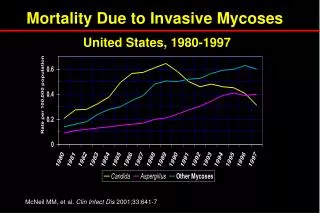
Mortality Due to Invasive Mycoses United States, 1980-1997 McNeil MM, et al. Clin Infect Dis 2001;33:641-7
Invasive Aspergillosis Mortality Review of Literature after 1995 Review of 1941 Patients from 50 Studies Lin S-J et al, Clin Infect Dis 2001; 32:358-66
IDSA Practice Guidelines for Aspergillus • Early management • Prompt, aggressive diagnosis (BIII) • Therapy initiated on suspicion of diagnosis (BIII) • Antifungal therapy • Intravenous therapy initiated (BIII) • AmB deoxycholate at maximum doses (1-1.5 mg/kg/d) (BIII) • Lipid AmB: impaired renal function or intolerance (AII) • Itraconazole: oral therapy, sequential use (CIII) • Adjunctive therapy: Surgery, combinations, immunotherapy (CIII) • New therapies and diagnostic tools needed to improve prognosis Stevens DA et al, Clin Infect Dis 2000;30:696-709
Invasive Aspergillosis: Disease Spectrum, Treatment Practices, & Outcome Underlying Disease (n) Complete/Partial Responses (%) Overall (595) 37% Severe Immunosuppression (363) 28 Allo BMT (151) 13 Hematological Malignancy (212) 39 Less Severe Immunosuppression (232) 51 Site of Infection Pulmonary (330) 40% Disseminated (without CNS) (114) 18 Central Nervous System (34) 9 Patterson TF, et al. Medicine, 2000;79:250-60
Trial Design for Invasive Mycoses • Limitations in trials for invasive mycoses • Relative infrequency • Difficult diagnosis (surrogate markers, high resolution imaging) • Host factors (underlying conditions, disease presentation) • Trial issues (slow enrollment, expensive, difficult, use of approved comparators, definitions/endpoints) • Large, prospective randomized trials for invasive aspergillosis: 2 • Ellis, 1998 (87 pts): Liposomal AmB 1 vs 4 • Bowden, 1998 (103 pts): ABCD vs D-AmB Rex JH et al, CID 2001;33:95-106; Patterson TF, et al. ICAAC 2000;abstract 1324.
Treatment of Invasive Aspergillosis: Unmet Medical Needs* Hiemenz, 1995 ABLC (n) Control (n) Historical Control 42% (151) 23% (122) Maertens, 2001 Caspofungin Control Historical Control 41% (56) 17% (206) Leenders, 1998 L-AmB D-AmB Open, Randomized 52% (25) 29% (28) Includes suspected infections *Complete & Partial Responses Hiemenz JW, et al. Blood 1995;86(suppl 1):849a; Maertens J, et al. ECCMID 2001;abstract O248; Leenders ACAP et al. Br J Haem 1998;103:205
Efficacy of Empirical L-AmB vs Amphotericin B Deoxycholate in Neutropenic Patients* L-AmB (343) AmB Deoxycholate (344) Aspergillus 12 15 Candida 3 12 Fusarium 1 1 Zygomycetes 1 0 Other 0 2 Total 17 (5.0%) 30 (8.7%) *Proven or probable breakthrough fungal infection Walsh TJ et al, New Eng J Med, 1999;340:764-71
Invasive Mycoses: Present and Future • Epidemiology • Increasing number of patients at risk • Changing patterns of disease • Major cause of morbidity and mortality • Improved prognosis • Prompt diagnosis • Host factors • Antifungal therapy • Early, aggressive “induction” antifungal therapy • New approaches and new agents needed