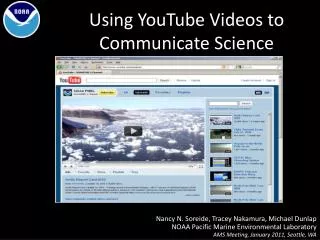
Using YouTube Videos to Communicate Science
150 likes | 285 Vues
This presentation from the AMS Meeting in January 2011 highlights the benefits of using YouTube videos to communicate complex scientific narratives, such as the Chile tsunami event. It emphasizes how videos can encapsulate information concisely, reach broad audiences, and serve as a continuous informational resource. The talk covers practical aspects, including video creation tools, playlist organization, usage statistics, and compliance considerations. Ideal for scientists aiming to enhance public engagement through impactful storytelling via multimedia.


Using YouTube Videos to Communicate Science
E N D
Presentation Transcript
Using YouTube Videos to Communicate Science Nancy N. Soreide, Tracey Nakamura, Michael DunlapNOAA Pacific Marine Environmental Laboratory AMS Meeting, January 2011, Seattle, WA
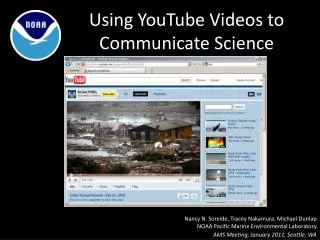
Chile tsunami event (Feb 27, 2010) YouTube video embedded in slide … or play from YouTube or local video file
Why? • Can tell a complicated story easily • Encapsulates it clearly in a few moments • Reaches a wide audience • Speaks for you all the time ….. even when you aren’t there • Helpful with press releases ….. helps the media get the story straight Click to play from YouTube or local video file
Why YouTube? YouTube Servers & Services! • Servers • Support streaming of large, long videos, in HD, with audio • Handle peak loads • Services • Video resolution matched to available bandwidth • Audio support (voice over, music, closed captioning for Section 508 compliance) • Videos organized by topic with Playlists • Usage statistics and analysis
Video usage statistics • Number of views • How people found it • Links to it • Hot spots
How do people find your videos? • Web pages link to it or embed it • Your web pages; other’s web pages • YouTube • your YouTube channel • YouTube suggests “videos of interest” • YouTube search function • YouTube subscription service sends a notice to subscribers when you post a new video
How hard is it to make a video? • What is your story? • Aim for simple story in short 1-3 minute video • Explanatory text written on video (e.g., North Pole web cam videos) • Voiceover (e.g., Arctic Report Card, Chile tsunami) • No added audio or text (e.g., tsunami propagation animations) • Stage directions or storyboard • Visuals • Photos, science graphics, animations, video clips or Google Earth animations • Public domain images from NOAA, Wikimedia Commons… • Audio • Voiceover or music or both • Public domain music e.g., Free Music Archive, http://freemusicarchive.org/ • Home movie-making software • Inexpensive, e.g., under $100 (we use Sony Vegas Movie Studio) • YouTube channel • Enterprise Level Agreement for YouTube channel • YouTube free upload (if consistent with organizational regulations)
NOAA PMEL YouTube channel www.youtube.com/noaapmel