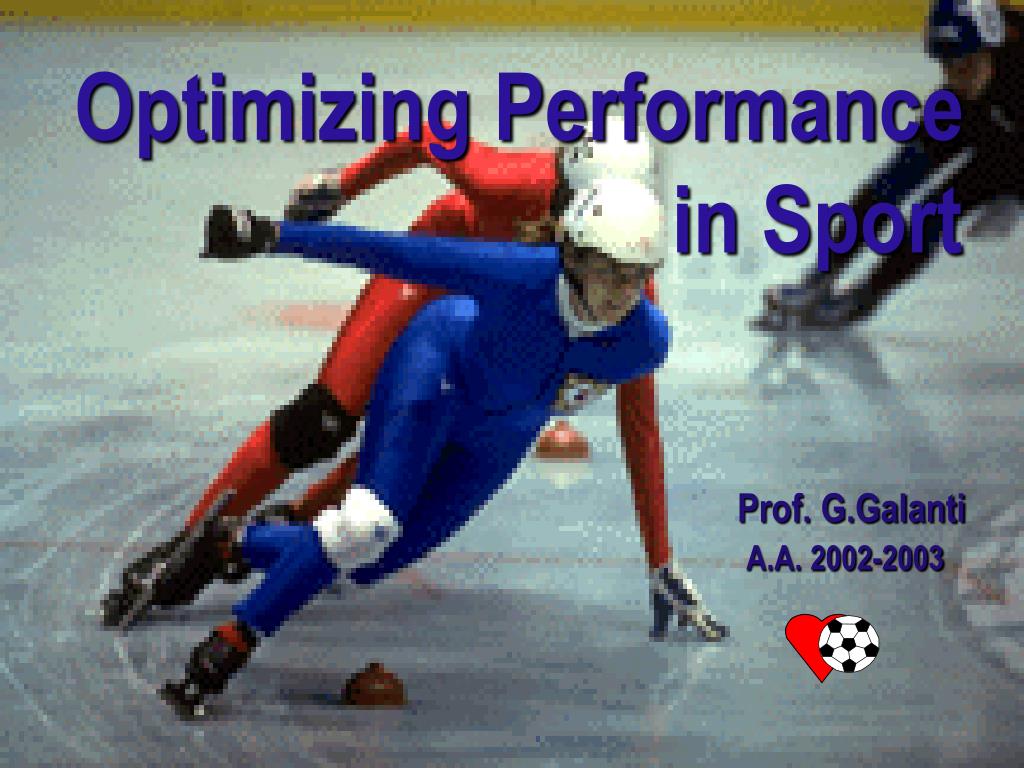
Optimizing Performance in Sport. Prof. G.Galanti A.A. 2002-2003. Sports training. It is the process that make the athletes able to improve their exercise performance, efficency and tolerance to physical stress. It represents the body adaptations
Une image / un lien ci-dessous est fourni (tel quel) pour télécharger la présentation
Politique de téléchargement : le contenu du site vous est fourni TEL QUEL pour votre information et votre usage personnel ; il ne peut être vendu, concédé sous licence ni partagé sur d’autres sites sans l’accord de son auteur.Le contenu vous est fourni TEL QUEL, pour votre information et votre usage personnel uniquement.Téléchargez la présentation en cliquant sur ce lien.Lors du téléchargement, si vous ne parvenez pas à télécharger une présentation, l’éditeur a peut-être supprimé le fichier de son serveur.Pendant le téléchargement, si vous ne parvenez pas à obtenir une présentation, le fichier a peut-être été supprimé par l’éditeur.
Sports training It is the process that make the athletes able to improve their exercise performance, efficency and tolerance to physical stress. It represents the body adaptations to chronic exposure to exercise. These adaptations are higly specific to the type of training, and their magnitude are related to thevolume (quantity) and intensity(quality) of Training.
CRMS “ Condizione Atletica” L’insieme di caratteristiche cardiorespiratorie, neuromuscolari e psicologiche ,naturali od acquisite,che permettono all’atleta di effettuare la prestazione sportiva con il massimo rendimento e con il minimo pericolo di infortunio
Quantifying Sport Training Demands of Training Over Training Tapering of Peak Performance Detraining Retraining Effects of OT Musc Strength Musc Power Musc End CardioRe End Flexibility Basic Principles ANS Hormon Immunity Volume Intensity Predicting OTS Blood Enz O2 cons ECG HR Treatment OTS
Basic Training Principles • The Principle of Individuality • The Principle of Specificity • The Principle of Progressive Overload • The Principle of Hard / Easy • The Principle of Periodization • The Principle of Disuse
Basic Training Principles 1. The Principle of Individuality Different people respond to the same training in different ways. Heredity plays a major role in determining how quickly and to what degree the athlete adapts to a training program. For these reasons any training program “must take into account the specific needs and abilities of the individuals for whom it is designed.”
Basic Training Principles 2. The Principle of Specificity To maximize the benefits, training must be specifically matched to the type of activity the athlete use to be engaged in. (endurance vs strenght and power training). By this principle the training program must stress the physiological systems that are critical for optimal athlete’s performance, in order to achieve specific adaptations for specific sports.
Basic Training Principles 3. The Principle of Progressive Overload Overload and Progressive Training are the foundation of all training programs. A well-designed Training Program must involve working the muscles, respiratory and cardiovascular systems harder than normal (overload); as the body adapts, Training progresses to a higher work level (progressive training)
Basic Training Principles 4. The Principle of Hard / Soft Bill Bowerman (former U.S. Olympic track coach and founder of NIKE) developed a training strategy for his distance running that became known as ‘ The principle of hard / soft’. According to this principle, one or two days of hard training should be followed by one day of soft training, allowing the fully recover of body and mind and prevent the athlete’s overtraining.
Importance of the diet Endurance athletes must pay particular attention to their carbohydrate intake in the periods of hard training, in order to avoid the depletion of glycogen reserves.
Basic Training Principles 5. The Principle of Periodization Periodization is the gradual cycling of specificity, intensity and volume of training to achieve peak levelsof fitness for competition.
Basic Training Principles 6. The Principle of Disuse “ Use it or loose it” According to this principle, training benefits are lost if training is either discontinued or reduced too abruptly. To avoid this, all training programs must include a maintenance program.
The Volume of Training Training volume can be increased by increasing either the duration or the frequency of training bouts. Numerous studies have shown no significant differences in improvment between athletes who train with typical training volumes and those who train with twice the volume
Volume of Training Changes in swimmers’s(a) blood lactate levels (b) heart rate during standarized swim during 25 wk of training, once (group1) or twice (group2) day
Intensity of training Training intensity relates to both the force of muscle action (strength and power training) and the stress placed on the cardiovascular system (aerobic training). Training Intensity is typically relate to the % of the athlete’s VO2 max.
Intensity of training Training intensity of between 50% and 90% VO2max produce marked improvement in aerobic capacity for most people
Overtraining The only way to continue to improve exercise performance with training is to progressively increase the training stress. However, when this concept is carried too far, pushing the body beyond its ability to adapt, the training may became excessive.
Overtraining An excessive training produces no additional improvement in conditioning or performance and can lead to a chronic state of fatigue that is associated with muscle glycogen depletion. This condition is termed Overtraining.
Overtraining Overtraining is an imbalance between exercise and recovery in which the athlete’s training program execeeds the body’s physiologic and psycologic limits and causes fatigue and reduced functional capacity.This problem results from a short-to medium-term increase in training volume and/or intensityover the athlete’s previously substantial baseline.
Developement of Overtraining Physical factors Emotional factors : Demands of competition Desire to win Fear of failure Unrealistically high goals OVERTRAINING Decline in performance accompained by a loss in competitive desire and a loss in enthusiasm for training
Developement of OvertrainingPhysical factors Too intense Training load Too high Training volume Excessive training Overcaming the body’s ability of recovering and adapting Overtraining syndrome Catabolism > Anabolism
Overtraining Syndrome Overtraining is characterized by a sudden decline in athlete’s performancethat cannot be remedied by a few days of rest and dietary manipulation. It must be distinguished from Fatigue that often follows one or more exhaustive training session that is usually corrected by a few days of rest and a carbohydrate-rich diet.
Overtraining Syndrome • Subjective sense of loss in muscular strenght, coordination and maximal working capacity • Decrease appetite and body weight loss • Muscle tenderness Principal symptoms
Overtraining Syndrome • Head colds, allergic reaction or both • Occasional nausea • Sleep disturbances • Elevated resting heart rate • Elevated blood pressure Other symptoms
Overtraining Syndrome The symptoms of overtraining are highly individualized and subjective, so they cannot be universally applied. The presence of one or more of these symptoms is sufficent to alert the coach or trainer that an athlete migth be overtrained
Hormonal response to Overtraining Testosterone Cortisol Thyroxine • Protein catabolism ( blood urea ) Testosterone/Cortisol Loss in lean body mass
Overtraining and Immunity One of the most serious consequences of overtraining is the depression of the immune response that places the athlete at an increased risk for infection and increase the risk of even greater complications.
Predicting overtraining syndrome Signs that have been considered for diagnosing overtraining • changes in blood levels of muscular enzymes (CK, LDH, SGOT) • Increased oxigen consumption at a fixed rate of work as performance becomes less efficent • Abnormal resting ECGs showing T wave inversion • Increased heart rate and blood lactate responses to a fixed rate of work
Predicting overtraining syndrome The best predictor of overtraining syndrome seems to be HR response to a standardized bout of work. The advantages of this test are : • providing an easly obtained , objective measurement of the athlete’s cardiovascular response to a given rate of work • providing a warning signal of developing overtraining syndrome
Treatment of overtraining syndrome Recovery from overtraining syndrome is only possible with a marked reduction in training intensity or complete rest.
Tapering for peak performance Many athletes decease their training intensity before a competition to avoid reductions in strength, power and performance capacity that accompany high-intensity training. This practice is called Tapering.
Less training is needed to maintain the gains previous attained with an intense training So Tapering does not lead to a loss of condictioning
Tapering for peak performance The most notable change during the Taper period is a marked increase in muscular strength which best explains the performance improvement that occurs.
Tapering for peak performance Tapering also allows time for the muscle to repair any damage incurred during intense training and for the energy reserves (muscular and liver glycogen) to be restored
Detraining May physical inactivity affect highly trained athletes?
Physiological responses to detraining • Muscular strength and power • Muscular endurance • Speed, agility and flexibility • Cardiorespiratory endurance
Connexion au compte
Connectez-vous pour publier votre contenu sur SlideServe.