Download

1 / 46
460 likes | 571 Vues
Explore the classification, mechanisms, and factors influencing allergic responses like IgE-mediated reactions. Discover the role of mast cells, allergen triggers, and molecular changes in PAR stimulation. Uncover the immunoregulatory disorders and hygiene hypothesis affecting allergies. Learn about Th1 and Th2 responses, Treg cells, and the 'old friends' hypothesis. Dive into the counter-regulation hypothesis and the role of regulatory T cells and IL-17 in allergic inflammation.

E N D
Hypersensitivity reactions marshnes@yahoo.com
Figure 1-32 Immune responses
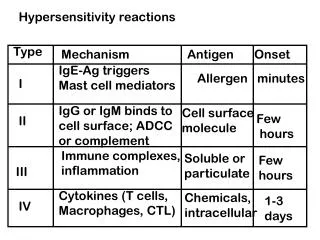
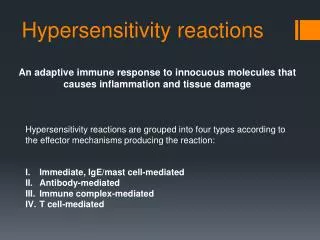
Hypersensitivity Reactions • Harmful immune responses against harmless ‘environmental’ antigens (pollens, food, drugs) • Classified into 4 type of reactions (Coombs & Gell), based on their effector mechanisms responsible for cell & tissue injuries
Classification Allergy has many faces Antibody/B cell- mediated allergy
Classification (contn’d) T cell-mediated Allergy
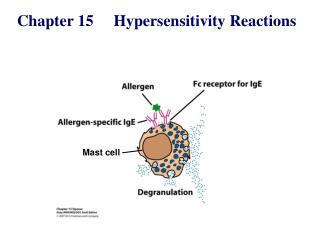
Type I Hypersensitivity reactions(immediate type)* Allergy the commonest type* IgE-mediated* Innocuous antigens: allergens
IgE antibodies • Mediate mast cell activation degranulation • Via their Fce that interact to FceRI with high affinity cytophilic (reaginic) Ab • Normal serum concentration: less than 1 mg/mL • Can rise to over 1000g/mL in severe atopy and helminthic infections • Has totally 5 Ig domains (4 constant and 1 variable heavy chains)
FceR • Fce R I • A high affinity receptor • Mast cells, basophils, activated eosinophils • Fce R II (CD23) • A low affinity receptor • B cells, activated T cells, monocytes, eos, platelets
Binding of IgE into its corresponding receptor: IgE-like domains of a-chain Mediate signal transduction
The nature of allergens • High soluble proteins • Presented to immune system: at very low doses • Enzymes frequently triggers allergy • Cysteine protease of house dust mite(Der p 1) • Phospholipase A2 in bee venom • Others: pollen, mold spores, latex, certain drug, ie. penicillin
Enzyme triggers allergy of the airway Dermatophagoides pteronyssimus Cysteine protease Der p 1
The role of protease & protease-activated receptors (PARs) • Principles • Extracellular exo-and endogenous protease (mites, molds) react with cell-surface receptor leukocyte infiltration, amplify allergic responses • PARs • 7-transmembrane proteins coupled to G proteins: PAR-1,2,3 and 4. PAR-2 is the most important • Expressed on the cells involved in allergic rhinitis and asthma: epithelium, mast cells, eosinophils, neutrophils, monocytes-macrophages, lymphocytes, smooth muscle, endothelium, fibroblasts, neurons
PAR stimulation • Increased intracell. Ca++, gene transcription • Epith.: opens tight junction, desquamation, produces cytokine, growth factors • Degranulates eosinophils, mast cells • Fibroblast: promotes proliferation, maturation, increase collagen prod. • Amplify IgE production • Bronchial muscle: contraction, proliferation • Trypsin (injured epith. cells), tryptase (mast cells)activ. PAR-2 • Chymase (mast cells) activ. PAR-2
Factors leading to IgE production • Two main signals • Polarization into Th2 phenotype • IL-4, IL-5, IL-9, IL-13 • Stimulate IgE switch by B cells • IL-4, IL-13
Contribution of genesand environmental factors Hygiene hypothesis (1989) Infections in early childhood Th1 response Non atopic
Positive interaction between infection and development of atopy RSV infection bronchiolitis Th2 cytokine production: IL-4 (away from IFN-g)
New theory: Immunoregulatory disorders • Modern living reducing contact with pathogens that prime Th1 response (1989) • Modern living conditions defective maturation of Treg and APCreg
The changes of theory? • Clinical evidence • Simultaneous autoimmunity-and IBD (Th1-mediated), and allergies (Th2-mediated) • Crucial factor: Teffector/Treg balance • Absence of immunoregulation develop Th1 or Th2-mediated inflammatory disorders • Depending on own Th1/Th2 bias, genetic background, immunological history
The ‘old friends’ hypothesis • Harmless microorganisms (helminths, saprophytic mycobacteria, lactobacilli) • Less contact with ‘old friends’ in modern living • Allergy: less frequent in hookworm n schistosomiasis • Less lactobacilli in the guts of children allergy; high doses of lactobacilli inhibits dev. of atopic eczema • M.vaccae maturation of Treg treat pre-existing allergy
modification of the hygiene hypothesis • “counter-regulation hypothesis”
“Counter-regulation hypothesis” • All types of infection • Produce IL-10, TGF-b down regulate Th1 n Th2 responses • PAMP TLRs of DC • LPS TLR-4, CpG DNA TLR-9, IFN-g indoleamine 2,3-dioxygenase (IDO) • DC IDO T reg suppress Th2-driven inflammation
Regulatory T cells (T reg) • Natural T reg (CD4CD25) • Defective in atopy (no suppression of Th2 cytokine production) • Defective in FoxP3 allergy, hyper IgE, airway inflammation
CD4 Th17 Allergy/inflammation • IL-17
Role of mast cells • Effector cells of immediate hypersensitivity • Contain cytoplasmic granules, whose contents are the major mediators of allergic reaction • Vasoactive amines, lipid mediators, cytokines • Two subpopulations are detected • Connective tissue (CTMC) and mucosal (MMC) • Specific locations within the tissues • Close to blood vessels, nerve, smooth muscles
Eosinophils • Reside in the connective tissue • Respiratory, gut, urogenital • Toxic granule proteins, radicals parasites • Chemical mediators • Prostaglandins, leukotrienes, cytokines inflammation • Chemokines • CXCL 8, Eotaxins: CCL11, CCL24, CCL26
Toxic proteins and inflammatory mediators of eosinophils , eotaxins
Sequence of events in allergic reaction • Initial exposure of antigen/allergen • Sampling by APC processing & presentation • Stimulation of CD4+T cells Th2 • IL-4 promotes B cells IgE AFC • Sensitization of mast cells degranulation • Immediate/early vascular & muscular changes • vascular permeability & vasodilatation, visceral and bronchial smooth muscle contraction • Late phase reactions, due to proinflammatory cytokines/chemokines • Infiltration & activation of inflammatory cells: eosinophils, basophils, neutrophils
Hypersensitivity in the gut • Food allergy • Celiac disease (gluten-sensitive enteropathy) • a-gliadin • Inflammatory bowel disease (IBD) autoimmune-based inflammatory reactions • overresponsiveness to commensal bacteria
Concluding remarks • Contributing factors to type I hypersensitivity reactions • Allergens • Proteins/molecules-bound to protein, low MW, low dose, enzymatically active, highly soluble • Combination of genetic and environmental factors • CD4+ Th cells, esp. Th2 responses • IL-4 and IL-13 cytokine production IgE switch factor • IgE (cytophilic) antibodies • Mast cells • FceRI