Download
1 / 12
160 likes | 283 Vues
This review covers the fundamental reactions of aldehydes and ketones, focusing on key processes such as oxidation and reduction. It details the oxidation of primary and secondary alcohols to their respective aldehydes and ketones, and further oxidation of aldehydes to carboxylic acids. The reduction of aldehydes and ketones to primary and secondary alcohols is explained, along with the synthesis of hemiacetals and acetals. A thorough understanding of these reactions is essential for applications in organic chemistry and chemical synthesis.

E N D
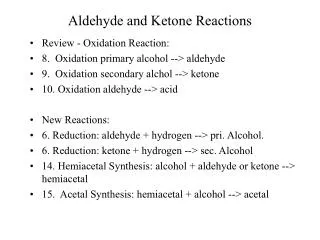
Aldehyde and Ketone Reactions • Review - Oxidation Reaction: • 8. Oxidation primary alcohol --> aldehyde • 9. Oxidation secondary alchol --> ketone • 10. Oxidation aldehyde --> acid • New Reactions: • 6. Reduction: aldehyde + hydrogen --> pri. Alcohol. • 6. Reduction: ketone + hydrogen --> sec. Alcohol • 14. Hemiacetal Synthesis: alcohol + aldehyde or ketone --> hemiacetal • 15. Acetal Synthesis: hemiacetal + alcohol --> acetal
Aldehyde and Ketone Reactions • Reduction: aldehyde + hydrogen --> pri. Alcohol • Form of addition reaction.
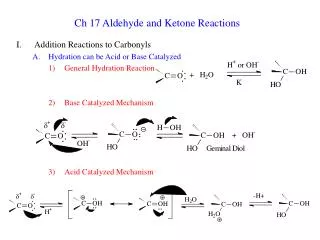
Reduction: aldehyde + hydrogen • Break hydrogen bond
Reduction: aldehyde + hydrogen • Break double bond and use electrons to bond with hydrogen.
Reduction: aldehyde + hydrogen • Brief Method
Hemiacetal and Acetal Functional Groups • Hemiacetal: alcohol and ether on same carbon • Acetal: Two ethers on same carbon
Hemiacetal Synthesis: aldehyde + hydrogen • Alcohol + aldehyde --> hemiacetal • Ethanal + methanol • Alcohol oxygen becomes an ether • Carbon double bond oxygen becomes an alcohol
Synthesis of Acetal Functional Group • Acetal: alcohol plus hemiacetal (ether synthesis) • Acetal: Two ethers on same carbon
Hemiacetal and Acetal Reactions • Ques. 13: Complete the following reactions: