Understanding Elements and Compounds: Properties and Classifications
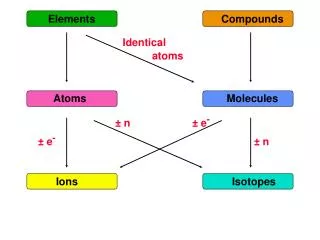
This document explores the fundamentals of elements and compounds, highlighting their definitions, properties, and classifications. Elements are described as pure substances that cannot be broken down further and consist of one type of particle, known as atoms. The properties of elements can be physical or chemical, which aid in their identification. Compounds, on the other hand, are pure substances formed from two or more elements joined together. The document also discusses how compounds can be broken down and provides examples of their importance in daily life and various industries.


Understanding Elements and Compounds: Properties and Classifications
E N D
Presentation Transcript
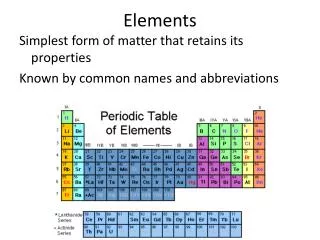
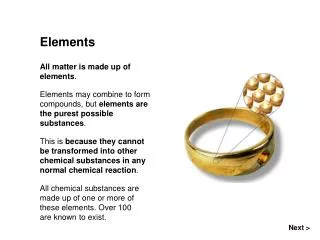
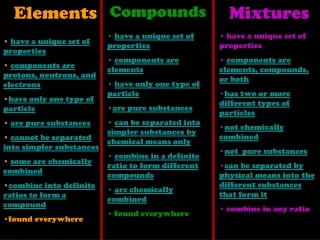
Elements, The Simplist Substance • Element: • A ______ ________ that ________ be broken down into simpler substances by physical or chemical means. • Pure Substance: • Substance in which there is only _____ type of particle • Each element contains only one type of particle (_____)
Properties of Elements • Each element has its own ____________ properties that will help __________ the element. • Physical properties • Chemical properties • Elements may share similar properties, but have other properties that will identify the substance.
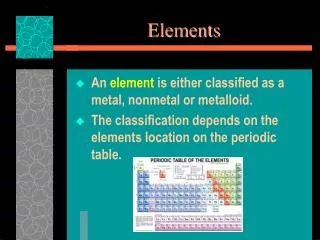
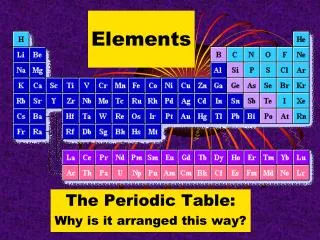
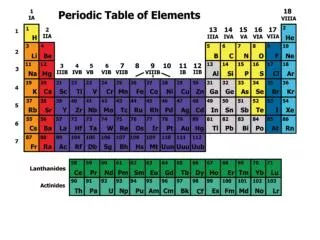
Classifying Elements by Their Properties • Categories of Elements: • __________: (Most Elements) • Shiny or Lustre • Conduct heat energy and electric current • Iron, nickel, cobalt • ___________: • Dull (solid) • Do not conduct heat energy and electric current • Carbon, sulfur, iodine • ___________: • Properties of both metals and nonmetals
Compounds • Compound: • Pure substance that is composed of two or more elements that are ___________ __________. • Combine by _________ (_________ __________) • Made up of molecules • Formed when atoms of 2 or more elements join • Elements join in a ________ _______ according to their _________ to form a compound • A ratio of a certain compound is always the same.
Properties of Compounds • May be identified by both physical and chemical properties. • Properties of _________ differ from those of the __________ that form them. • Ex: Sodium Chloride (Table Salt) • Sodium reacts violently with water • Cholorine is a poisonous gas Properties: Compounds vs. Elements
Breaking Down Compounds • Some compounds may be broken down into ________ by _______ change. • Some break down into simpler __________. • Carbonic Acid breaks down into carbon dioxide and water. • Break down through ________ _________ • Need _________ • Heat • Electric current (electrolysis) Methods of Breaking Down Compounds
Compounds in Your World • Food • School Supplies • Clothes • Compounds found in nature usually need to be broken down for use in industry. • Aluminum – produced by breaking down aluminum oxide • Ammonia - nitrogen + hydrogen • ___________ are compounds found in living things • Need the element nitrogen to make proteins • __________ ________ is needed by plants to produce carbohydrates • Produce energy for plants and animals Compounds in Industry Compounds in Nature