Download
1 / 17
170 likes | 277 Vues
This report presents the extended range weather prediction for India during the 2013 season utilizing an Ensemble Prediction System based on CFSv2 and GFSv2, forced with bias-corrected forecasted sea surface temperatures (SST). Initial conditions from September 3, 2013, indicate that rainfall activity will be near normal to below normal across much of the country, except in the Peninsula, which may experience active convective conditions over the next ten days. The methodology involves advanced perturbation techniques and bias corrections for accurate forecasting.

E N D
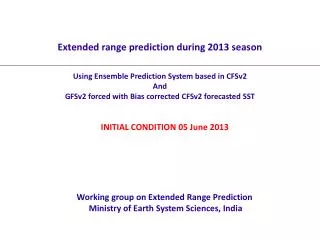
Extended range prediction during 2013 season Using Ensemble Prediction System based in CFSv2 And GFSv2 forced with Bias corrected CFSv2 forecasted SST INITIAL CONDITION 3rd September 2013 Working group on Extended Range Prediction Ministry of Earth System Sciences, India
Key points from the present analysis • Forecast shows that rainfall activity is likely to be near normal to below normal over most parts of the country except Peninsula for the next four pentads. • Real time forecast for MISO shows that associated convective activity is likely to be active over Peninsula for the next 10 days. The convective activity will weaken thereafter.
Strategy: Ensemble Prediction using CFS/GFSv2 (T126) • Ocean and Atmospheric Initial conditions (IC) are obtained from NCEP. • Technique was developed to perturb ICs to generate 11 members. (Abhilash et al., 2013) • Model has been integrated for 45 days for each 11 ICs at five day intervals starting from 16th May (Eg: 16May, 21May, 26May, 31May, 05Jun........etc). Climatology has been calculated from 10-year hindcast climatology. • Bias correction in daily forecasted SST from CFSv2 for each lead time has been done by removing the daily mean bias for corresponding lead time (model climatology-observed climatology) from forecasted daily SST. (Sahai et al., 2013; Abhilash et al., 2013)
FORECAST FROM CFSv2(T126) And Bias Corrected GFS2(T126) Based on IC 3rd September 2013
Daily evolution of rainfall and wind at 850hPa [CFS forecast based on IC=3 Sep 2013]
Daily evolution of rainfall and wind at 850hPa GFS forecast forced with bias corrected CFS forecasted SST based on IC=3 Sep 2013
Daily evolution of vorticity and wind at 200hPa [CFS forecast based on IC=3 Sep 2013]
Daily evolution of vorticity and wind at 200hPa GFS forecast forced with bias corrected CFS forecasted SST based on IC=3 Sep 2013c
Daily evolution of vorticity at 850hPa, mslp [CFS forecast based on IC=3 Sep 2013]
Daily evolution of vorticity at 850hPa, mslp GFS forecast forced with bias corrected CFS forecasted SST based on IC=3 Sep 2013
CFS-GFS Forecast Over Homogenous Regions MZI, CEI, NEI, NWI & SPI