Understanding Average and Instantaneous Velocity: Key Concepts in Kinematics
This article explores the critical distinctions between average and instantaneous velocity in kinematics. Speed, defined as a scalar quantity, only measures how fast an object is moving without indicating direction. In contrast, velocity is a vector that includes both speed and direction, allowing for positive or negative values depending on the movement's direction. We'll delve into how these concepts apply in real-world scenarios, emphasizing the importance of precise terminology in physics for clear communication and understanding.

Understanding Average and Instantaneous Velocity: Key Concepts in Kinematics
E N D
Presentation Transcript
Kinematics 2 Average and Instantaneous Velocity 2-2, 2-3
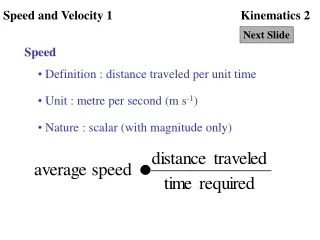
Speed • Speed is a scalar. • No direction. • Your car does not have a velocitometer. It does not tell you direction. • Your car’s speedometer indicates the speed only. • In physics, we must be very precise when using the terms speed and velocity.
Velocity • Vector • Speed plus direction • Speed is the magnitude of the velocity vector • Can be positive or negative to indicate the direction
Instantaneous Velocity • The “average” velocity over an infinitesimally short period of time.