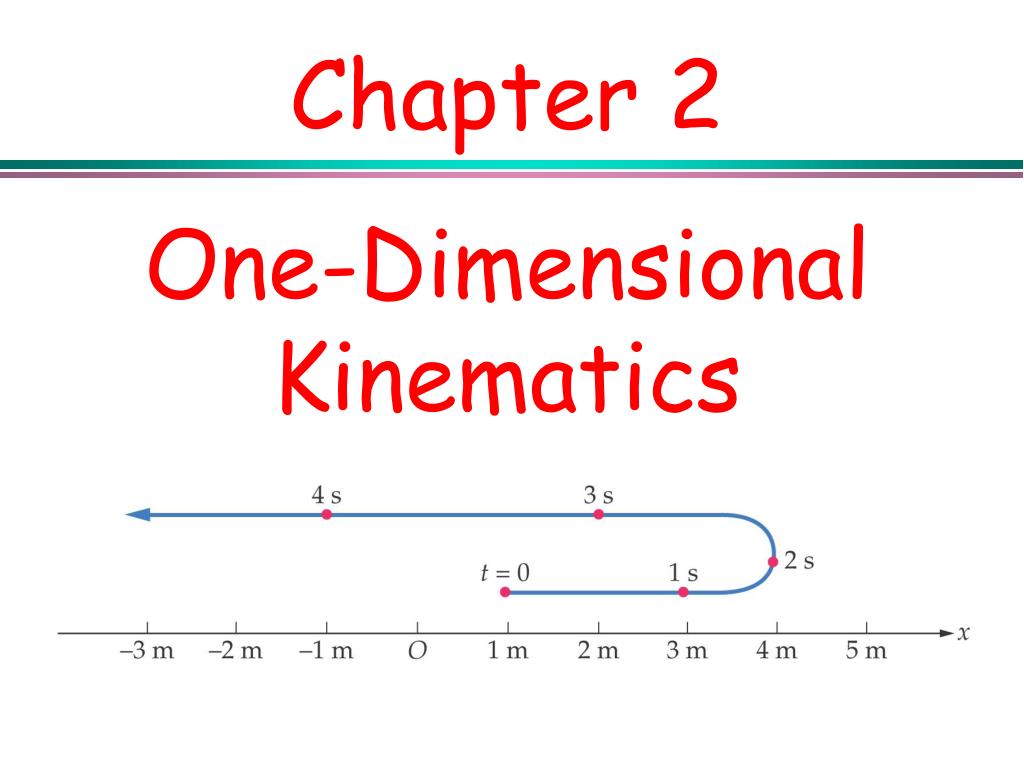
Chapter 2 One-Dimensional Kinematics. Kinematics. It is the branch of mechanics that describes the motion of objects without necessarily discussing what causes the motion. 1-Dimensional Kinematics (or 1-Dimensional motion) refers to motion in a straight line.
Une image / un lien ci-dessous est fourni (tel quel) pour télécharger la présentation
Politique de téléchargement : le contenu du site vous est fourni TEL QUEL pour votre information et votre usage personnel ; il ne peut être vendu, concédé sous licence ni partagé sur d’autres sites sans l’accord de son auteur.Le contenu vous est fourni TEL QUEL, pour votre information et votre usage personnel uniquement.Téléchargez la présentation en cliquant sur ce lien.Lors du téléchargement, si vous ne parvenez pas à télécharger une présentation, l’éditeur a peut-être supprimé le fichier de son serveur.Pendant le téléchargement, si vous ne parvenez pas à obtenir une présentation, le fichier a peut-être été supprimé par l’éditeur.
Kinematics • It is the branch of mechanics that describes the motion of objects without necessarily discussing what causes the motion. • 1-Dimensional Kinematics (or 1-Dimensional motion) refers to motion in a straight line.
Distance • The total length traveled by an object. • “How far have you walked?” is a typical distance question. • The SI unit of distance is the meter (m).
Displacement (Dx) • The change in the position of a particle is called displacement. • is a Greek letter used to represent the words “change in”. x therefore means “change in x”. It is always calculated by final value minus initial value.
B A Distance vs... Displacement 100 m • A picture can help you distinguish between distance and displacement. displacement 50m distance
Questions • Does the odometer in your car measure distance or displacement?
A B 5 m 2 m Practice Problem: Two tennis players approach the net to congratulate one another after a game. a) Find the distance and displacement of player A. b) Repeat for player B.
Practice Problem: If x is the displacement of a particle, and d is the distance the particle traveled during that displacement, which of the following is always a true statement? • d = |Dx| • d < |Dx| • d > |Dx| • d > |Dx| • d < |Dx|
Practice Problem A particle moves from x = 1.0 meter to x = -1.0 meter. What is the distance d traveled by the particle? What is the displacement of the particle?
Average Speed • Average speed describes how fast a particle is moving. The equation is: • where: vav = average speed d = distance t = elapsed time • The SI unit of speed is the m/s Average speed is always a positive number.
Average Velocity • Average velocity describes how fast the displacement is changing. The equation is: Average velocity is + or – depending on direction. • where: vav = average velocity x = displacement t = elapsed time • The SI unit of velocity is the m/s.
Instantaneous Velocity • The velocity at a single instant in time. • If the velocity is uniform, or constant, the instantaneous velocity is the same as the average velocity. • If the velocity is not constant, than the instantaneous velocity is not the same as the average velocity, and we must carefully distinguish between the two.
x Dx Dt t Instantaneous Velocity vins = Dx/Dt Draw a tangent line to the curve at B. The slope of this line gives the instantaneous velocity at that specific time. B
Acceleration (a) • Any change in velocity over a period of time is called acceleration. • The sign (+ or -) of acceleration indicates its direction. • Acceleration can be… • speeding up • slowing down • turning
Questions • If acceleration is zero, what does this mean about the motion of an object? • Is it possible for a racecar circling a track to have zero acceleration?
Uniform (Constant) Acceleration • In Physics B, we will generally assume that acceleration is constant. • With this assumption we are free to use this equation: • The SI unit of acceleration is the m/s2.
Acceleration in 1-D Motionhas a sign! • If the sign of the velocity and the sign of the acceleration is the same, the object __________. • If the sign of the velocity and the sign of the acceleration are different, the object __________.
Position vs.... Time Graphs • Particles moving with no acceleration (constant velocity) have graphs of position vs.... time with one slope. The velocity is not changing since the slope is constant. • Position vs.... time graphs for particles moving with constantacceleration look parabolic. The instantaneous slope is changing. In this graph it is increasing, and the particle is speeding up.
Uniformly Accelerating Objects • You see the car move faster and faster. This is a form of acceleration. • The position vs.... time graph for the accelerating car reflects the bigger and bigger Dx values. • The velocity vs... time graph reflects the increasing velocity.
Describe the motion • This object is moving in the positive direction and accelerating in the positive direction (speeding up). • This object is moving in the negative direction and accelerating in the negative direction (speeding up). • This object is moving in the negative direction and accelerating in the positive direction (slowing down).
x v a t t t Acceleration vs... time Position vs... time Velocity vs... time Draw Graphs forStationary Particles
Connexion au compte
Connectez-vous pour publier votre contenu sur SlideServe.