

1 / 4

Message from Asia

The IAF/GEOSS Seminar held at UNESCO HQ on June 19, 2007, focused on the importance of international coordination for global Earth observations, technology development, and their societal benefits. With insights from Tad Inada of JAXA and representatives from NASA, discussions included the transition toward a cohesive Earth observation system, enhancing decision-making for societal needs, and addressing climate change. The seminar highlighted the integration of satellite and in-situ observations to support disaster management and environmental monitoring, leveraging data from GOSAT and other observations.
dugan
Télécharger la présentation

Message from Asia

An Image/Link below is provided (as is) to download presentation Download Policy: Content on the Website is provided to you AS IS for your information and personal use and may not be sold / licensed / shared on other websites without getting consent from its author. Content is provided to you AS IS for your information and personal use only. Download presentation by click this link. While downloading, if for some reason you are not able to download a presentation, the publisher may have deleted the file from their server. During download, if you can't get a presentation, the file might be deleted by the publisher.

E N D

Presentation Transcript


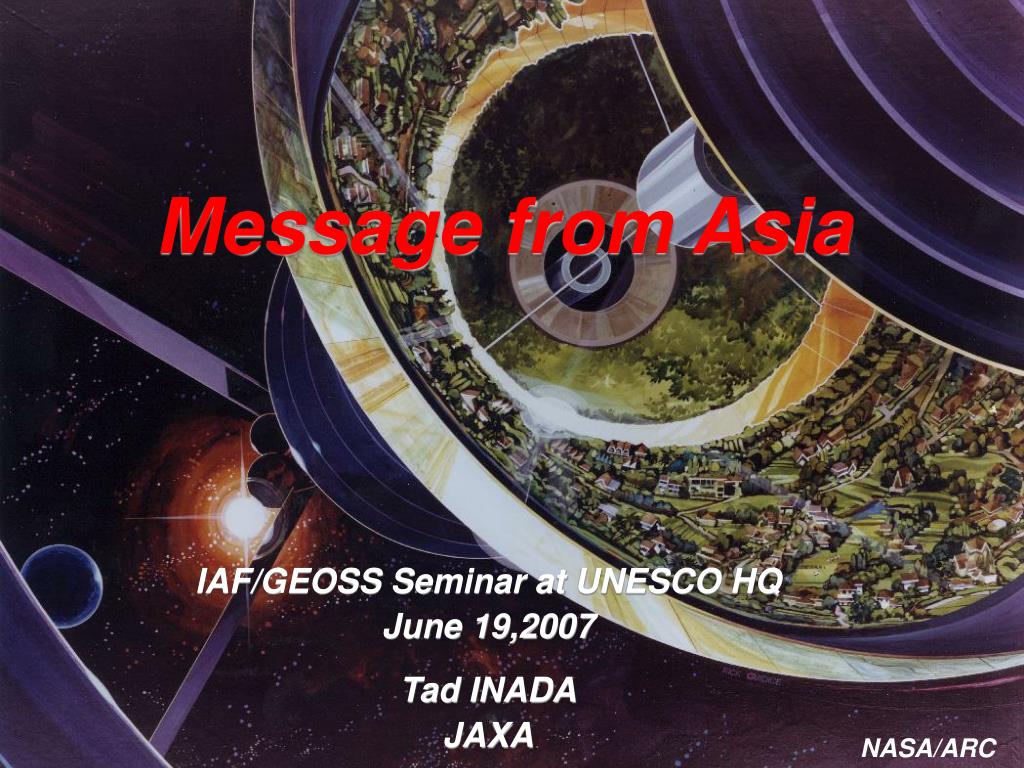
  1. Message from Asia IAF/GEOSS Seminar at UNESCO HQ June 19,2007 Tad INADA JAXA NASA/ARC

  2. Transition International Coordination for Global Earth Observations Technology Learning Technology Development Earth Environment Science Societal Benefit, Decision Making Support GEOSS G8 Evian★ Summit ★ EO Summit Level of ・Integration ・Societal benefit ・Decision making Realization of GEOSS in 10 years SAC★ Long-term vision IGOS Strategy for integrating satellite and in-situ observations G7 ★Summit CEOS Int’l coordination for maximizing return from satellite Earth observations Creation of IGOSProposal of EO Summit 1995 2005 1985 Year

  3. Support adaptation to climate change GOSAT enables global (with 56,000 points) and frequent (at every 3 days) monitoring CO2 and CH4 column density. Current Ground-based Observation Points (320pts) Provided by WMO WDCGG (launch in 2008) Increase of Observation Points using GOSAT (56,000pts) Simulated CO2 distribution as observed by GOSAT by National Institute for Environmental Studies

  4. Support early warning for Disaster Prevention and Relief Observation System Observationand Archive Data Capacity Building Disaster Management Agencies Information Sharing Platform Data Data Digital Asia ALOS JAXA, MODIS stations ALOS Rapid Response System Warning Refuge Rescue

More Related