
SlideServe
Menu
Préférences
© SlideServe · v2026

Longest common subsequence (LCS) Problem

duke avatar
7 diapositives · 486 Views · Jan 04, 2013

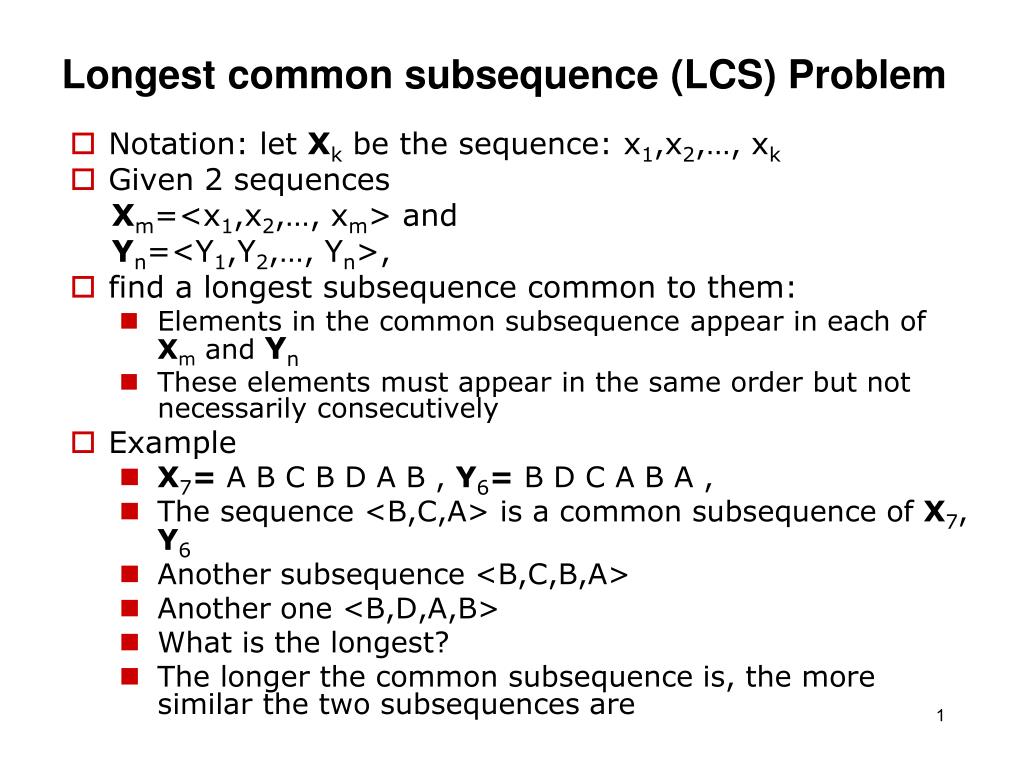
Longest common subsequence (LCS) Problem. Notation: let X k be the sequence: x 1 ,x 2 ,…, x k Given 2 sequences X m =<x 1 ,x 2 ,…, x m > and Y n =<Y 1 ,Y 2 ,…, Y n >, find a longest subsequence common to them: Elements in the common subsequence appear in each of X m and Y n
Longest common subsequence (LCS) Problem - slide 1
01 / 7Longest common subsequence (LCS) Problem
1 / 17

Télécharger la présentation

Longest common subsequence (LCS) Problem
Une image / un lien ci-dessous est fourni (tel quel) pour télécharger la présentation

Politique de téléchargement : le contenu du site vous est fourni TEL QUEL pour votre information et votre usage personnel ; il ne peut être vendu, concédé sous licence ni partagé sur d’autres sites sans l’accord de son auteur.Le contenu vous est fourni TEL QUEL, pour votre information et votre usage personnel uniquement. Téléchargez la présentation en cliquant sur ce lien. Lors du téléchargement, si vous ne parvenez pas à télécharger une présentation, l’éditeur a peut-être supprimé le fichier de son serveur.Pendant le téléchargement, si vous ne parvenez pas à obtenir une présentation, le fichier a peut-être été supprimé par l’éditeur.

F I N

Plus de contenu associé

Transcription de la présentation
  1. Longest common subsequence (LCS) Problem • Notation: let Xk be the sequence: x1,x2,…, xk • Given 2 sequences Xm=<x1,x2,…, xm> and Yn=<Y1,Y2,…, Yn>, • find a longest subsequence common to them: • Elements in the common subsequence appear in each of Xm and Yn • These elements must appear in the same order but not necessarily consecutively • Example • X7= A B C B D A B , Y6= B D C A B A , • The sequence <B,C,A> is a common subsequence of X7, Y6 • Another subsequence <B,C,B,A> • Another one <B,D,A,B> • What is the longest? • The longer the common subsequence is, the more similar the two subsequences are

  2. Characterizing the problem • Find LCS of the two sequences: Xm = <x1, x2, …, xm> & Yn = <y1, y2, …, yn> • Let Zk= <z1, z2, …, zk> be any LCS of Xm and Yn • If xm= yn , then zk= xm= yn we must find a LCS Zk-1 of Xm-1 and Yn-1 (appending xm= yn to this LCS yields a LCS of Xm and Yn) 2. If xm yn , then we must solve two sub-problems: • Finding a LCS of Xm-1 and Yn (if zk xm) • Finding a LCS of Xm and Yn-1 (if zk yn) Whichever of these two sequences is longer is a LCS of Xm, Yn

  3. c[m-1][ n-1]+1 if x[m]=y[n] c[m][ n]= Max ( c[m][ n-1], c[m-1][ n] ) otherwise C[3,4] C[2,3] C[2,4] C[3,3] C[1,2] C[1,3] C[2,2] C[1,3] C[1,4] C[2,3] C[2,2] C[2,3] C[3,2] C[1,2] C[1,3] C[2,2] Computing the length of a LCS • Let c[m][n] be the length of a LCS of Xm and Yn

  4. A recursive solution LCS (Array X, Array Y, int m, int n) { if ((m == 0) || (n == 0)) return 0; if (X[m] == Y[n]) return LCS(X, Y, m-1, n-1) + 1; else return max(LCS(X, Y, m, n-1), LCS(X, Y, m-1, n)); }

  5. A DP solution LCS-Length(X, Y, c){ m  length[X]; n  length[Y]; for (i= 1 to m) c[i][0]  0; for (j= 1 to n) c[0][j]  0; for i= 1 to m for j= 1 to n If xi = = yj c[i][j] =c[i-1][j-1]+1; else c[i][j] = max(c[i-1][j], c[i,][j-1]); }

  6. Computing a LCS The algorithm always decrement m or n or both so, in the worst case, its run time O(m+n) LCS-print (X, m, n, c) { if (c[m][n]==0) return if (c[m][n]==c[m-1][n]) LCS-print (X, m-1, n, c) if (c[m][n]==c[m][n-1]) LCS-print (X, m, n-1, c) else { LCS-print (X, m-1, n-1, c) Print xm } }

  7. Example let X7=<ABCBDAB> & Y6=<BDCABA> find LCS of X7, Y6?