Challenges and Successes in Beam Condition Setup and Feedback Mechanisms
This report summarizes the recent experimental efforts involving a 10 Hz ramp feedback, highlighting both successes and setbacks encountered during the beam condition setup. Significant issues included delays transitioning from a previous experiment, difficulties with tune measurements due to a tripped sextupole, and extended times needed for collisions. Efforts were made to work in parallel to recover lost time, but these were ultimately unsuccessful. Various parameter measurements, such as dynamic beta squeeze and beam-beam space charge, were conducted, with the impact of weather noted on experiment progress.

Challenges and Successes in Beam Condition Setup and Feedback Mechanisms
E N D
Presentation Transcript
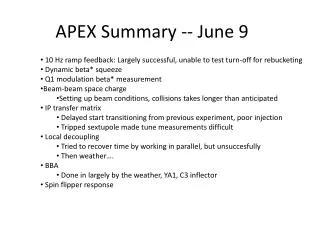
10 Hz ramp feedback: Largely successful, unable to test turn-off for rebucketing • Dynamic beta* squeeze • Q1 modulation beta* measurement • Beam-beam space charge • Setting up beam conditions, collisions takes longer than anticipated • IP transfer matrix • Delayed start transitioning from previous experiment, poor injection • Tripped sextupole made tune measurements difficult • Local decoupling • Tried to recover time by working in parallel, but unsuccesfully • Then weather…. • BBA • Done in largely by the weather, YA1, C3 inflector • Spin flipper response APEX Summary -- June 9