Composition of FSTs in Lexical and Morphological Analysis: A Summary
Learn about cascading FSTs, composing FSTs into a single mapping from lexical to surface level, orthographic rules for spelling changes, and how orthographic rules can be integrated with FSTs to generate word forms efficiently.

Composition of FSTs in Lexical and Morphological Analysis: A Summary
E N D
Presentation Transcript
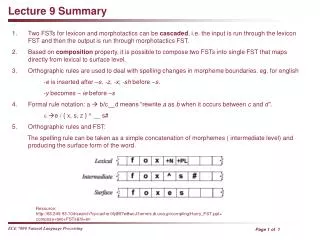
Lecture 9 Summary • Two FSTs for lexicon and morphotactics can be cascaded, i.e. the input is run through the lexicon FST and then the output is run through morphotactics FST. • Based on composition property, it is possible to compose two FSTs into single FST that maps directly from lexical to surface level. • Orthographic rules are used to deal with spelling changes in morpheme boundaries. eg. for english • -e is inserted after –s, -z, -x; -sh before –s. • -y becomes – ie before –s • Formal rule notation: a b/c__d means “rewrite a as b when it occurs between c and d”. • e / { x, s, z } ^ __ s# • Orthographic rules and FST: • The spelling rule can be taken as a simple concatenation of morphemes ( intermediate level) and producing the surface form of the word. Resource: http://66.249.93.104/search?q=cache:0lytBt7w8wcJ:hermis.di.uoa.gr/compling/Harry_FST.ppt+compose+two+FSTs&hl=en