The Nervous System
Chapter 9 explores the general functions of the nervous system in maintaining homeostasis through sensory information processing and motor response coordination. It highlights the two main divisions: the Central Nervous System (CNS), which includes the brain and spinal cord for conscious and unconscious control, and the Peripheral Nervous System (PNS), which connects the CNS to the body. It details the roles of neurons, neuroglial cells, and the classification of neurons based on structure and function. Understanding these concepts is essential for grasping how the nervous system operates.
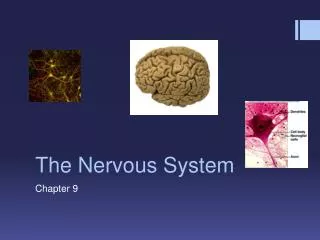

The Nervous System
E N D
Presentation Transcript
The Nervous System Chapter 9
General Functions of Nervous System Maintain HOMEOSTASIS by: • Receiving, interpreting and integrating sensory information from the environment • Sending signals to muscles and glands so they can respond
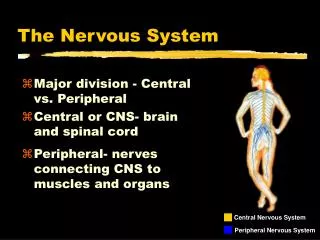
Divisions of Nervous System • Central Nervous System (CNS) • Brain • Spinal cord • Controls all conscious and unconscious activity • Peripheral Nervous System (PNS) • Cranial nerves • Spinal nerves • Connects CNS to the rest of the body
Divisions of PNS • Somatic NS • Nerves that connect to skeletal muscles and skin • Controls voluntary/consciousresponses • Autonomic NS • Nerves that connect to viscera, heart, smooth muscle, glands • Controls involuntary/subconscious responses
Divisions of Autonomic NS • Sympathetic NS • Regulates body’s responses to stress, anger, fear, anxiety… • Controls “fight or flight” mechanisms • Parasympathetic NS • Restores homeostatic conditions after stress, anger, fear… • Controls “rest and digest” mechanisms
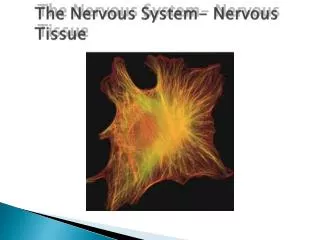
Cells of the Nervous System • Neurons -found in CNS and PNS -have unique cells and structure -transmit signals to other neurons • Neuroglial Cells -neuron “helper” cells; not neurons themselves -Found only in CNS
Neurons • Include • Dendrites, cell body, and axon • Dendrites receiveimpulses and send them to cell body • Axons transmitimpulses away from cell body
Neurons in PNS • axons are surrounded by SCHWANN CELLS • Schwann cell membranes have MYELIN in them • NEURILEMMA- extra protection around axon • NODES OF RANVIER: narrow gaps in the myelin sheath between Schwann cells
Neurons in CNS • Some axons have myelin (MYLELINATED) others don’t (UNMYELINATED) • Myelin in CNS comes from Oligodendrocytes • Myelinated axons appear as white matter • Unmyelinated axons are gray matter
Can we fix it? • Peripheral neurons are able to regenerate if damaged • Myelin sheath is surrounded by a tube of neurilemma • CNS neurons are not able to regenerate if damaged • Not surrounded by neurilemma
More on Neurons • Neurons can be classified based on structure • Multipolar-brain and SC • Bipolar-eyes, nose, ears • Unipolar-ganglia outside CNS
More on Neurons • Neurons can be classified based on function: • Sensory Neurons- (afferent) carry impulses from body parts to brain or spinal cord (unipolar, some bipolar) • Interneurons- lie entirely within the brain or spinal cord (CNS); transmit impulses from one part of the brain or spinal cord to another. (Multipolar) • Motor Neurons- (efferent) carry impulses out of the brain or spinal cord to effectors (multipolar)
Neuroglial Cells • Fill spaces, support neurons, provide structural frameworks, produce myelin, and carry on phagocytosis. • Types: microglial, oligodendrocytes, astrocytes, ependymal cells, schwann cells