Download
1 / 18
180 likes | 298 Vues
This chapter highlights the fundamentals of flowing fluids and pressure variation, focusing on the visualizations and distinctions between pathlines, streaklines, and streamlines. We explore Lagrangian and Eulerian perspectives in fluid dynamics, emphasizing Euler’s equation of motion. Key topics include pressure calculation in static fluids and the applications of Bernoulli's equation in fluid motion. The chapter also discusses the conditions under which these equations apply and introduces concepts like continuity and local vaporization.

E N D
Chapter 4: Flowing Fluids & Pressure Variation (part 2) Review visualizations Frames of reference (part 1) Euler’s equation of motion
Quick review of visualizations • Pathline - follows path of a single “fluid particle” • one particle • one starting point • several times • Streakline - connecting the dots from several particles passing the same point at different times • several particles • one starting point • one time • Streamline - tangent to the velocity • several particles • starting point irrelevant • tangent to velocity • one time • All three can be useful (depending on the flow) • Pathlines, streamlines, streaklines are the same in steady flows.
Two helpful distinctions • Laminar vs. turbulent flow • Lagrangian vs. Eulerian descriptions • Lagrangian: follow particle • Eulerian: measure local velocities, etc.
Quantitative description of motion • How do we quantitatively describe moton … of a solid particle?? … of a fluid particle??
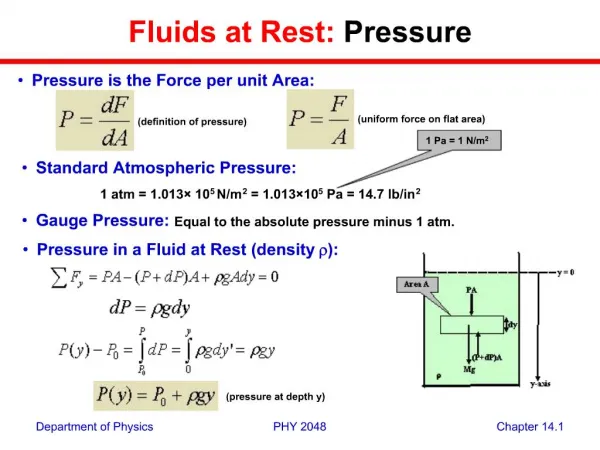
First pressure review (under pressure?) • How can we find pressure in a fluid: ….. in a gas?? ….. in a liquid?? Let’s start by answering this for static fluids.
Euler’s equation • F=ma • Valid for inviscid, incompressible flow only!
Euler’s equation • Consider the fluid-filled accelerating truck. • Where is the pressure greatest? • How can we calculate the pressure of B relative to that of A?
Euler derivation, continued • Now… what about the pressure difference between B and C? Which is greater? • How can we calculate the pressure of C relative to that of B? Relative to that of A?
Euler derivation, continued • Now, what do we do when g is not perpendicular to acceleration direction? • Let’s answer this for a more general case.
Euler’s equation • F=ma • Valid for inviscid, incompressible flow only!
Chapter 4: Flowing Fluids & Pressure Variation (part 3) Euler’s equation of motion review Bernoulli’s equation of motion Types of fluid motion (part 2) Rotational motion
Bernoulli’s equation • F=ma along a streamline • Steady flow assumption required
Bernoulli’s equation • Assumptions • Viscous effects are negligible • Steady flow (time-independent) • Incompressible flow • Valid along a streamline • Equation (think energy conservation)
Bernoulli – a simple application ?? ?? ?? ?? (a) (b) (c)
An analogous example: Holes in a soda bottle; flow from base of dam Now, how do we calaculate the velocity of the fluid as it leaves the tank? (or soda bottle)?
Continuity • Q = flow rate • If v = average velocity through a cross sectional area of area A Q = vA
Venturi What is the pressure at 2? Local vaporization can occur when the pressure falls below vapor pressure