Download
1 / 16
160 likes | 276 Vues
This study explores the process of chemical freeze-out in heavy ion collisions, focusing on the role of Hagedorn resonances in achieving equilibrium. We present master equations for decay processes and propose estimates for equilibration times, analyzing baryon-anti-baryon decay widths. By delving into the production mechanisms of baryon-anti-baryon pairs, we highlight the complexities of reaching equilibrium and how Hagedorn states contribute to this dynamic. Our findings suggest the potential for pairs to be born out of equilibrium, emphasizing the need for further research into time scales involved.

E N D
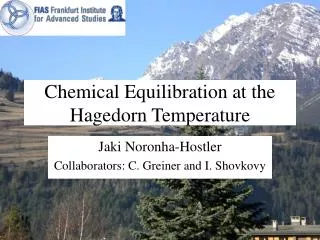
Chemical Equilibration at the Hagedorn Temperature Jaki Noronha-Hostler Collaborators: C. Greiner and I. Shovkovy
Outline • Motivation: understanding chemical freeze-out in heavy ion collisions • Hagedorn Resonances • Master Equations for the decay • Parameters • Estimates of Equilibration times • Baryon anti-baryon decay widths • Conclusions and Outlook
Motivation - chemical eq. time • Standard hadron gas: • Kapusta and Shovkovy, Phys. Rev. C 68, 014901-1 (2003) • Greiner and Leupold, J. Phys. G 27, L95 (2001) • Huovinen and Kapusta, Phys. Rev. C 69, 014901 (2004) • Some suggest long time scales imply that the hadrons are “born in equilibrium” • Heinz ,Stock, Becattini… Can’t explain apparent equilibrium
Production of anti-baryons • production • production • annihilation rate chemicalequilibration time • Rapp and Shuryak, PRL 86, 2980 (2001) • Greiner and Leupold, J. Phys. G 27, L95 (2001) detailed balance
Motivation • Baryon anti-baryon production lower by a factor of 3-4 • Can be produced through where HS are mesonic Hagedorn resonances with time scales of t=1-3 fm/c. • Greiner, Koch-Steinheimer, Liu, Shovkovy, and Stoecker Huovinen and Kapusta
Hagedorn Resonances • In the 1960’s Hagedorn found a fit for an exponentially growing mass spectrum • Provides extra degrees of freedom near the critical temperature to “push” hadrons into equilibrium
Master Equations for the decay • master equation
Parameters • Hagedorn States (mesonic, non-strange) M=2-7 GeV • Branching Ratios • Gaussian distribution: • Decay Widths Hammer ‘72 Future: microcanonical model Ranges from Gi=250-1090 MeV
Estimates of Equilibration times: HS $ nπ • Case 1: Pions are held in equilibrium • Case 2: Hagedorn States are held in equilibrium
Estimates of Equilibration times: HS$ nπ • Case 3: Both are out of equilibrium • Quasi-equilibrium- when the right hand side goes to zero before full equilibrium is reached. = 0 (Quasi-equilibrium)
Estimates of Equilibration times: HS $ nπ • Quasi-equlibrium is reached on the time scales of Case 1 and Case 2 • Because resonances decay into many pions a small deviation of the pions from equilibrium makes it more difficult for the resonances to reach equilibrium
Baryon anti-Baryon decay widths (Fuming Liu)
Estimates of Equilibration times: • Case 1: Pions are held in equilibrium Reminder: HS appear only near Tc!
Estimates of Equilibration times: • Case 2: Hagedorn States are held in equilibrium • Case 3: Pions and Hagedorn States are held in equilibrium
Estimates of Equilibration times: • Case 4: All are out of equilibrium
Conclusions and Outlook • Our preliminary results and time scale estimates indicate that baryon anti-baryon pairs can be born out of equilibrium. • Fully understand time scales when all particles are out of equilibrium • Include a Bjorken expansion to observe the fireball cooling over time (already done) • Improve branching ratios by using a microcanonical model • Include non-zero strangeness… in the baryon anti-baryon part