Download
1 / 1
20 likes | 147 Vues
This discussion session focuses on the innovative Hard Coherent and XPCS techniques, highlighting key scientific drivers in the study of soft and biomolecular materials, such as membranes, nanoparticle suspensions, and polymers. It addresses the capabilities of NSLS-II in enabling experiments that were previously unattainable, emphasizing the critical technical requirements for beamlines and detectors. Additionally, the session explores the necessary software infrastructure and accelerator specifications to support high-performance data acquisition and analysis for future research in advanced materials.

E N D
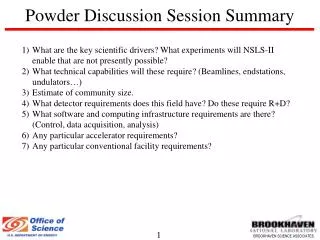
Hard Coherent and XPCS Technique Discussion Session • What are the key scientific drivers? xpcs - dynamics of soft & biomolecular materials (membranes, nanoparticle suspensions, polymers, surface fluctuations of thin films); cdi - nonbiological nanostructures, nanocomposite materials, magnetic materials as well as materials defects, precipitates What experiments will NSLS-II enable that are not presently possible? xpcs - dynamics that occurs between 10msec-100nsec range; cdi - images of non-crystalline or finite-sized objects to 0.1 nm resolution • What technical capabilities will these require? (Beamlines, endstations, undulators…) high-b straight with U19 undulator unless the U14 SCU becomes available, energy range of 7-20 keV although it was discussed whether lower (5KeV) energies gave more brightness, differentially pumped front-end, two parallel beamlines with two hutches for small-angle & wide-angle xpcs+cdi (side-deflecting mirrors), pink-beam and si monos,focusing optics, 2+4 type goniometer with 3m detector arm, hexapod sample manipulator, anomalous scattering or polarization fluctuations at resonance may be important but open issue whether the gains (phase retrieval or orientational fluctuations) justified higher heat loads of low energies. This would also require precise energy tunability. • Estimate of community size. depends on whether data acquistion and analysis software can be made user friendly • What detector requirements does this field have? fast pixel array detector with autocorrelators hard-wired to each pixel. Should design with 60mm pixels in mind.Do these require R+D? yes • What software and computing infrastructure requirements are there? (Control, data acquisition, analysis) without proposed detector, xpcs will require data acquisition rates > gbytes/sec, cdi requires high performance computer for phase retrieval. Cdi also requires advances in phase retrieval techniques especillay for the study of extended samples. • Any particular accelerator requirements? horiz.&vert. beam centroid stable to 0.2mm, h&v beam divergence stable to 1.0&0.1mrad for 100msec. to 2hrs. • Any particular conventional facility requirements? onebeamline that extends into LOM.