Report on Influenza-like Illnesses in Communities – Wave 3 Overview
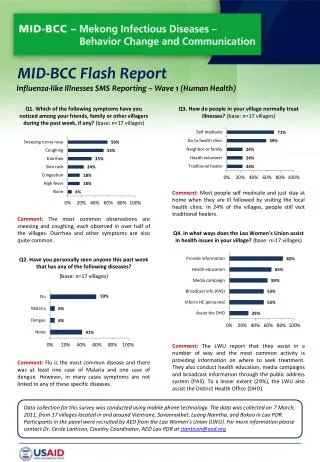
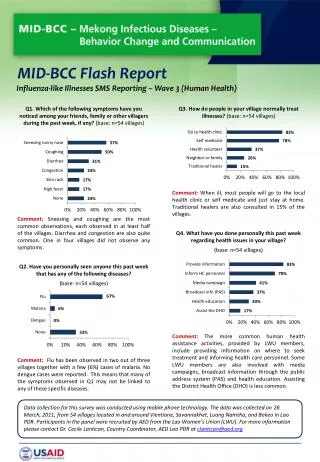
This report provides insights into the prevalence of influenza-like illnesses observed in 54 villages across Lao PDR during the past week. Key findings highlight sneezing and coughing as the most common symptoms reported by participants, with diarrhea and congestion also significant. Flu cases were noted in two-thirds of villages, whereas malaria accounted for 6% of reported illnesses. The report also discusses treatment methods, with many individuals seeking local health clinics, self-medicating, or consulting traditional healers. Data was collected on March 28, 2011.

Report on Influenza-like Illnesses in Communities – Wave 3 Overview
E N D
Presentation Transcript
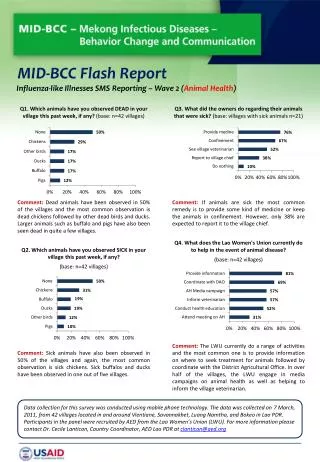
MID-BCC Flash Report Influenza-like Illnesses SMS Reporting – Wave 3 (Human Health) • Q1. Which of the following symptoms have you noticed among your friends, family or other villagers during the past week, if any? (base: n=54 villages) • Comment: Sneezing and coughing are the most common observations, each observed in at least half of the villages. Diarrhea and congestion are also quite common. One in four villages did not observe any symptoms. • Q2. Have you personally seen anyone this past week that has any of the following diseases? • (base: n=54 villages) • Comment: Flu has been observed in two out of three villages together with a few (6%) cases of malaria. No dengue cases were reported. This means that many of the symptoms observed in Q1 may not be linked to any of these specific diseases. • Q3. How do people in your village normally treat illnesses? (base: n=54 villages) Comment: When ill, most people will go to the local health clinic or self medicate and just stay at home. Traditional healers are also consulted in 15% of the villages. • Q4. What have you done personally this past week regarding health issues in your village? • (base: n=54 villages) • Comment: The more common human health assistance activities, provided by LWU members, include providing information on where to seek treatment and informing health care personnel. Some LWU members are also involved with media campaigns, broadcast information through the public address system (PAS) and health education. Assisting the District Health Office (DHO) is less common. Data collection for this survey was conducted using mobile phone technology. The data was collected on 28 March, 2011, from 54 villages located in and around Vientiane, Savannakhet, LuangNamtha, and Bokeo in Lao PDR. Participants in the panel were recruited by AED from the Lao Women’s Union (LWU). For more information please contact Dr. Cecile Lantican, Country Coordinator, AED Lao PDR at clantican@aed.org