Induction and Graph Theory: Key Concepts in Discrete Structures
This lecture dives into induction principles and their application in discrete structures and graph theory. It covers essential terminology related to graph connectivity—such as walks, cycles, and connected components—and explains graph coloring techniques along with two-way bounding strategies. The discussion also includes practical examples of induction, including the domino falling problem and mathematical proofs demonstrating the validity of claims for natural numbers. Essential concepts like weak and strong induction, alongside illustrative examples, provide a comprehensive understanding of these foundational topics.

Induction and Graph Theory: Key Concepts in Discrete Structures
E N D
Presentation Transcript
Induction http://www.picshag.com/recursive-painting.html Discrete Structures (CS 173) Madhusudan Parthasarathy, University of Illinois
Last lecture: graphs and 2-way bounds • Terminology for graph connectivity • Walk, path, cycle, acyclic, closed, Euler circuit, distance, diameter, connected components • Graph coloring and how to apply it • How to use two-way bounding in a variety of settings
Two-way bounding: set equality Claim: For any integer , is equal to .
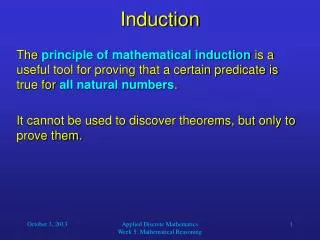
This lecture (and next): Induction • What is induction • Examples
Does domino n fall? • Suppose domino k falls. Then domino k+1 falls.
Does domino n fall? • Suppose domino k falls. Then domino k+1 falls. • The first domino falls
Induction Inductive hypothesis: Suppose domino k falls. Inductive conclusion: Domino k+1 falls. Base case: The first domino falls.
Simple math example Claim: for all natural integers .
Basic structure of induction proof Claim: Inductive step: Base case: is true. Weak Induction Inductive conclusion Inductive hypothesis Strong Induction Inductive conclusion Inductive hypothesis
Another math example Claim: For ,
Number theory example Claim: For any natural integer , is divisible by .
Geometrical example Claim: For any positive integer , a checkerboard with one corner square removed can be tiled using right triminos. right trimino
Things to remember • Induction requires demonstrating a base case and an inductive step • Inductive step usually involves showing that or • Typically, this requires writing in terms of
Next class • Induction with graphs, stamps, and games