
SlideServe
Menu
Préférences
© SlideServe · v2026

Enhancing ELL Education with Sheltered Instruction and Hands-On Learning Strategies

dyre avatar
10 diapositives · 236 Views · Jul 18, 2014

This comprehensive approach to teaching English Language Learners (ELLs) integrates sheltered instruction with hands-on learning techniques to support language acquisition and content mastery. By focusing on comprehensible input, cooperative learning, and vocabulary instruction, this model aligns with best practices advocated by Dr. Stephen Krashen. Strategies include utilizing visuals, modeling, and structured group interactions that draw on students' background experiences. The goal is to create a language-rich environment where ELLs can actively engage in their learning process while receiving tailored support.
Enhancing ELL Education with Sheltered Instruction and Hands-On Learning Strategies - slide 1
01 / 10Enhancing ELL Education with Sheltered Instruction and Hands-On Learning Strategies
1 / 17

Télécharger la présentation

Enhancing ELL Education with Sheltered Instruction and Hands-On Learning Strategies
Une image / un lien ci-dessous est fourni (tel quel) pour télécharger la présentation

Politique de téléchargement : le contenu du site vous est fourni TEL QUEL pour votre information et votre usage personnel ; il ne peut être vendu, concédé sous licence ni partagé sur d’autres sites sans l’accord de son auteur.Le contenu vous est fourni TEL QUEL, pour votre information et votre usage personnel uniquement. Téléchargez la présentation en cliquant sur ce lien. Lors du téléchargement, si vous ne parvenez pas à télécharger une présentation, l’éditeur a peut-être supprimé le fichier de son serveur.Pendant le téléchargement, si vous ne parvenez pas à obtenir une présentation, le fichier a peut-être été supprimé par l’éditeur.

F I N

Plus de contenu associé

Transcription de la présentation
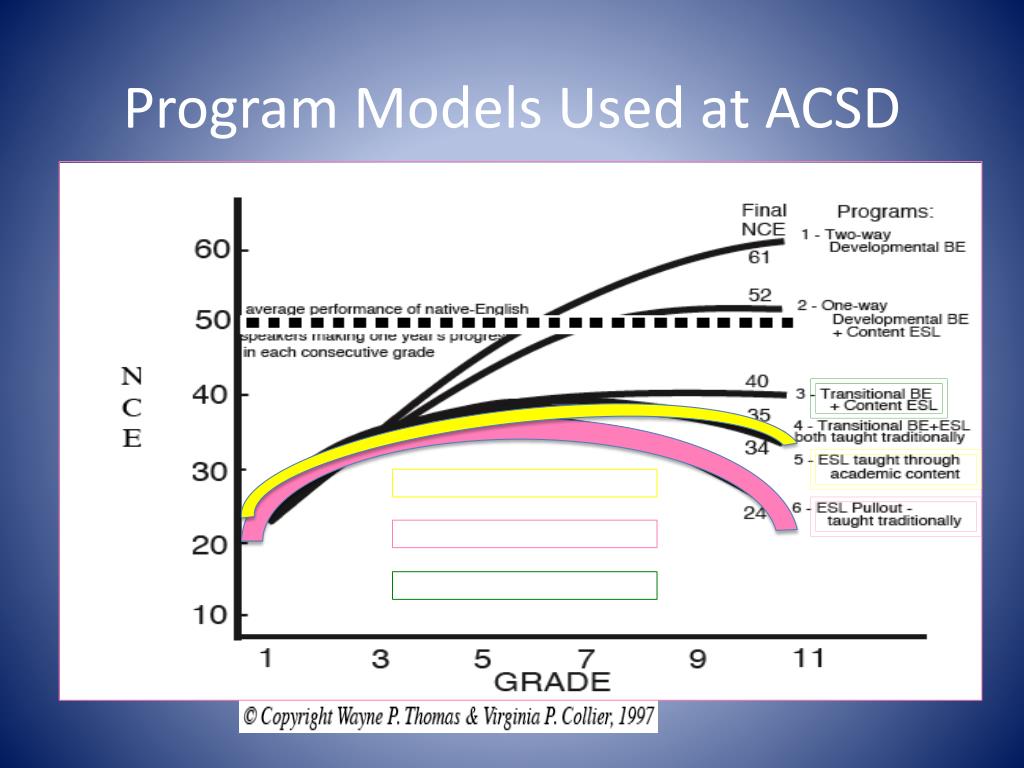
  1. Program Models Used at ACSD Intended practice (what our plan states) Current practice with some students First language influence or support

  2. Dale’s Cone of Experience

  3. Sheltered Instruction for Content and Language Instruction • Combines philosophies, strategies , and techniques that recognize the multifaceted challenges that ELLs confront in school • Introduced by Dr. Stephen Krashen in the early 1980s • Focuses on grade level-content that is understandable. • Provides instruction that is comprehensible, relevant, and motivating • Emphasizes language and content objectives

  4. Sheltered Instruction • The goal of sheltered instruction is to increase comprehensible input by differentiation and modification that is: • constructive • conscious • consistent

  5. Sheltered Instruction • Cooperative learning • Structured - to practice speaking, 90 minutes a week, one on one is recommend by Institute of Education Sciences (2008) • Hands-on • Via manipulatives - provide support to learning. • Guarded vocabulary • pre-teaching, contextual, repetition, exposure • Speech • Visuals/Realia

  6. Cooperative Learning • Support ELL learning through strong peer modeling. • Encourage ELL speaking through small group interaction. • Assign each person in group a role to ensure participation. • Draw on the background experiences of each group member.

  7. Hands-On Learning • Support ELL learning through modeling and personal experience. • Encourage ELL learning through explicit, hands-on connections. • Reinforce hands-on learning with speaking and writing connections.

  8. Vocabulary Instruction • Teach vocabulary in context • Emphasize students’ active role in the learning process. • Give students tools to expand word knowledge independently. • Reinforce word learning with repeated exposures over time. • Stimulate students’ awareness and interests in words. • Build a language-rich environment to support word learning. • Use academic language that is supported by student-friendly language and rephrasing (K. Brooks, 2006)

  9. Modify Your Speech • Speak at a slow/normal pace • Provide wait time • Enunciate your words (going tonot gonna) • Use simple sentence structure (avoid passive verbs and complex clauses) • Use high frequency words • Use cognates • Reduce the complexity of your language but still emphasize key content vocabulary • (K. Brooks, 2006)

  10. Visuals & Realia • Speak at a slow/normal pace • Provide wait time • Enunciate your words (going to not gonna) • Use simple sentence structure (avoid passive verbs and complex clauses) • Use high frequency words • Use cognates • Reduce the complexity of your language but still emphasize key content vocabulary (K. Brooks, 2006)