
Biomes
E N D
Presentation Transcript
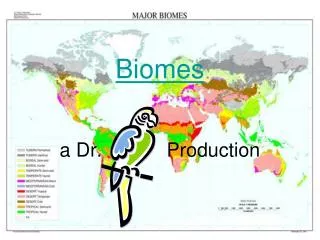
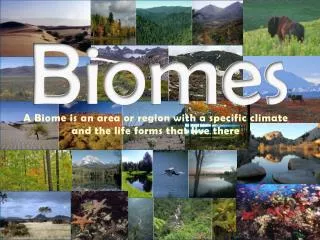
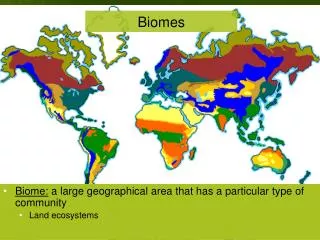
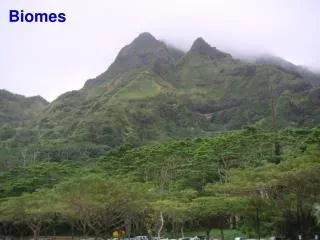
What is a Biome? • Biome- A geographical area that is characterized by the climate, plants, and animals of that area
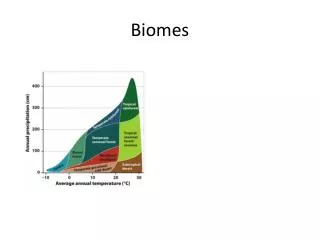
Deciduous Forest • Deciduous means ‘to fall off’ • Trees conserve water in winter by losing leaves • Georgia is a deciduous forest biome. • Have warmer winters, longer summers and more rainfall than taiga • Avg. rainfall 29.5-49 inches • Avg. temp. Summer 82F and Winter 43 F
Taiga • Also known as coniferous forest • Composed of conifers, or trees that produce seeds in cones • Cool summers and long cold winters with snow • South of the Tundra • Avg. rainfall 14-29.5 inches • Avg. temp. Summer 57F and Winter 14F
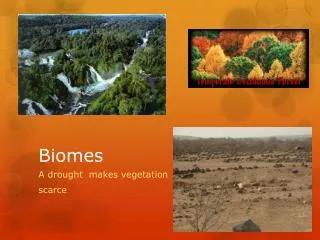
Tropical Rain Forest • Most diverse biome • Warm, rainy climate year round • Found near the equator • Avg. rainfall 157.5 inches! • Avg. temp. Daytime 93F and Nighttime 68F
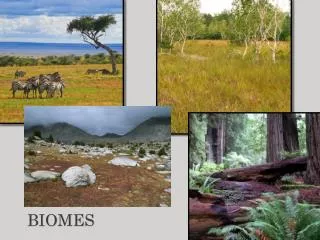
Savanna • Tropical grassland with scattered clumps of trees and shrubs • Includes animals such as elephants, giraffes, zebra, lions • Warm temperatures with wet seasons and dry seasons • Avg. rainfall 59 inches • Avg. temp. Summer 93F and Winter 61F
Tundra • Also known as the “cold desert” • Treeless and dry • Has permafrost • Avg. rainfall 12-20 inches • Avg. temp. Summer 53.6F and Winter -14F
Desert • Hot, dry region with less than 25 cm of rain per year • Some may have cold winters and many have cold nights • Supports a variety of plants and animals that have adapted to the desert • Avg. rainfall less than 10 inches • Avg. temp. Summer 100F and Winter 45F
Grassland • Grasses mixed with a few flowering plants • Support small seed eating mammals and large herbivores • Avg. rainfall 10-29.5 inches • Avg. temp. Summer 86F and Winter 32F
Marine Ecosystems • Intertidal Zone- The region between the highest tide line and the lowest tide line. • Neritic Zone- The region following the intertidal zone just above the continental shelf. This is the most productive zone in the ocean with lots of animal life
Marine Ecosystems • Oceanic Zone is the open ocean. It is the largest marine zone and makes up most of the world’s oceans. • Benthic Zone is the sea floor which extends horizontally from the neritic zone through the open ocean.
Freshwater Ecosystems • Freshwater ecosystems can be found in the Earth’s ponds, lakes, streams, and rivers.
Freshwater Ecosystem • Wetland- An ecosystem in which water either covers the soil or is near the soil’s surface for all or part of the year. Wetlands include marshes and swamps. • Marsh-a treeless wetland • Swamp- a wetland with trees and vines
Freshwater Ecosystems • Wetlands often form at estuaries • An estuary is the place at the mouth of a river where fresh water and salt water mix
How is a biome different from an ecosystem? • 1.Biomes are made of many related ecosystems.
2. • South America and Africa
3. • Plenty of rain and moderate temperatures.
4. • Shrubs and Deciduous trees
5. • In cones
6. • The evergreen conifers shade the forest floor, but the deciduous trees of the temperate forest allow light to reach the ground.
7. • Coniferous forests get less rainfall than some other biomes.
8. • Most of the animals are found in the trees.
9. • The plants grow above the ground to get sunlight which is lacking on the forest floor.
10 • Camouflage, hiding burrows
11 • The savanna gets about twice as much rain
12 • Escaping the heat and hiding from predators
13 • 10 in
14 • Growing close to the ground helps protect the plants from the cold and wind
15 • They are both large herbivores
Section 1 Review • 1. Tundras, like deserts, receive little rainfall. • Tundra is not hot like most deserts, so it is a “frozen desert”
Temperate Grassland • Abiotic factors- warm summers cold winters • Type of producers- grass with scattered trees • Type of consumers- • Herbivores- prairie dogs, bisons, • Predators- coyotes
Savanna • Abiotic factors- constant warmth with seasonal rains • Types of producers- scattered trees • Types of consumers- • herbivores: elephants, giraffes, zebras, and wildebeest • Predators:lions
3 • Some plants have special roots to gather rainfall before it evaporates. Many desert plants can store water in their stems or roots
4 • Alpine tundra- found at the tops of tall mountains • Polar tundra is found at or near the poles