Understanding Joint Types: Structural and Functional Categories
Joints in the human body can be classified into structural and functional categories. Structurally, they include fibrous joints where bones are joined by fibrous tissue, cartilaginous joints where bones are joined by cartilage, and synovial joints with a fluid-filled space lined with a synovial membrane. Functionally, joints are categorized as immovable (synarthroses), slightly movable (amphiarthroses), or freely movable (diarthroses). This classification aids in understanding how different joints provide varying degrees of movement.

Understanding Joint Types: Structural and Functional Categories
E N D
Presentation Transcript
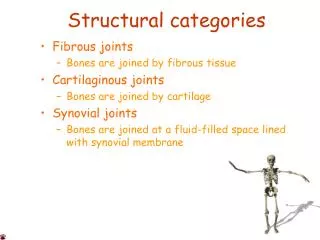
Structural categories Fibrous joints Bones are joined by fibrous tissue Cartilaginous joints Bones are joined by cartilage Synovial joints Bones are joined at a fluid-filled space lined with synovial membrane
Functional categories Immovable joints Bones don’t move relative to one another Synarthroses Usually fibrous joints Slightly movable joints Bones can move, but not much Amphiarthroses Usually cartilaginous Freely movable joints Bones have significant movement Diarthroses Synovial joints