Structural Damage Categories
This guide provides a comprehensive overview of structural damage categories including Light, Moderate, and Heavy damage. Light damage is deemed safe to enter, focusing primarily on superficial issues like fallen plaster and small cracks. Moderate damage raises concerns about structural stability, with significant tilting and foundation displacement. Heavy damage indicates unsafe conditions, such as wall collapse or ceiling failure, where entry is strictly prohibited. This information is crucial for assessing the safety of buildings following natural disasters such as earthquakes.

Structural Damage Categories
E N D
Presentation Transcript
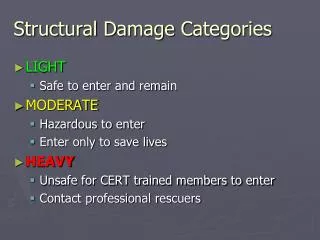
Structural Damage Categories • LIGHT • Safe to enter and remain • MODERATE • Hazardous to enter • Enter only to save lives • HEAVY • Unsafe for CERT trained members to enter • Contact professional rescuers
Light Damage • Superficial • Cosmetics • Fallen plaster • Small cracks • Primary damage to contents of structure
Moderate Damage • Structural stability questionable • Fractures greater than 1/4” • Significant Tilting • Foundation Movement or Displacement
Heavy Damage • Partial or total wall collapse • Ceiling failure • Obvious structural instability • X-cracking
X - CRACKING • Questionable Stability • Don’t enter • Beware of the impact zone
Single Family Home - Pre-1933 • Foundation Movement • Not bolted down • Cripple wall failure • Utilities • Utility lines shear when home moves off foundation • Porches • Attached parts of homes will detach • Moderate damage expected
SFH - Hillside • Unique hazards • Ground failure • Heavy damage expected • Always treated as HEAVILY DAMAGED during periods of earthquake
Hillside - Cut & Fill • Fractures homes at the original grade point